by David E. Petzal
What follows was triggered (so to speak) by my learning that the Army’s new rifle, the XM7, weighs 9.84 pounds with suppressor. The M1 Garand that was issued in 1938, and with which we won World War II, weighed 9.5 pounds. The M1 was considered scandalously heavy by military planners. However, when I was wearing a green suit and saluting a lot, there were a great many soldiers still on active duty who had fought with the Garand in World War II and Korea and, to a man, they swore by it. I never heard one of them whine about its weight.
Weight in rifles and shotguns, especially barrel weight, can do good things. It lets you hold steady and, if you’re swinging the gun at a moving target, it keeps you swinging. The key to this is balance. British gunmakers, long ago, figured out balance. If you’ve had experience with London rifles and shotguns (especially double rifles) you’ve noted that they feel lighter than they weigh.
A heavy barrel cuts recoil almost as effectively as a muzzle brake, and without the earsplitting report. One of the most effective rifles I’ve ever owned was a .375 H&H that was built by the late David Gentry on his own version of the Model 98 Mauser action. It had a synthetic stock and a #3 contour barrel, which is medium weight. He built just what I asked for, but it kicked, and the kick made fast, aimed, shooting impossible, so I had the rifle retrofitted with a 22-inch Schneider #5½ barrel, which is a sporter contour, but has some heft to it. Then I had two mercury recoil-reducing tubes installed in the butt.
The resulting rifle was short (A 22-inch barrel does just fine for the .375 H&H.) and handy. The recoil reducers balanced out the barrel. The rifle weighed 11 pounds, loaded. It pushed rather than bucked, and you could stay on target with it as you emptied the magazine. I took it on numerous safaris, shot all manner of beasts with it, never let a tracker carry it, and never felt burdened.
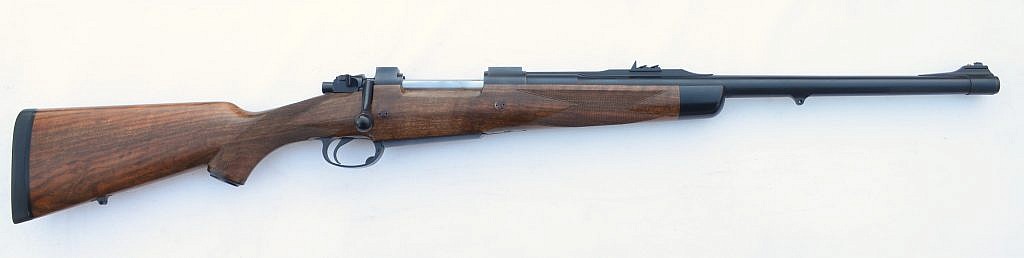
Two decades after I got it, I was hunting in Zimbabwe with a South African PH whose stopping rifle was a custom Magnum Mauser chambered for the huge .505 Gibbs cartridge. His rifle looked just like mine, scaled way up. The massive barrel was also 22 inches long. This fellow had done a lot of shooting with hard-kicking rifles and had come to the same conclusions I had. I think his rifle weighed 13 pounds, but since he himself was enormous—as many Boers are—the weight didn’t bother him a bit.
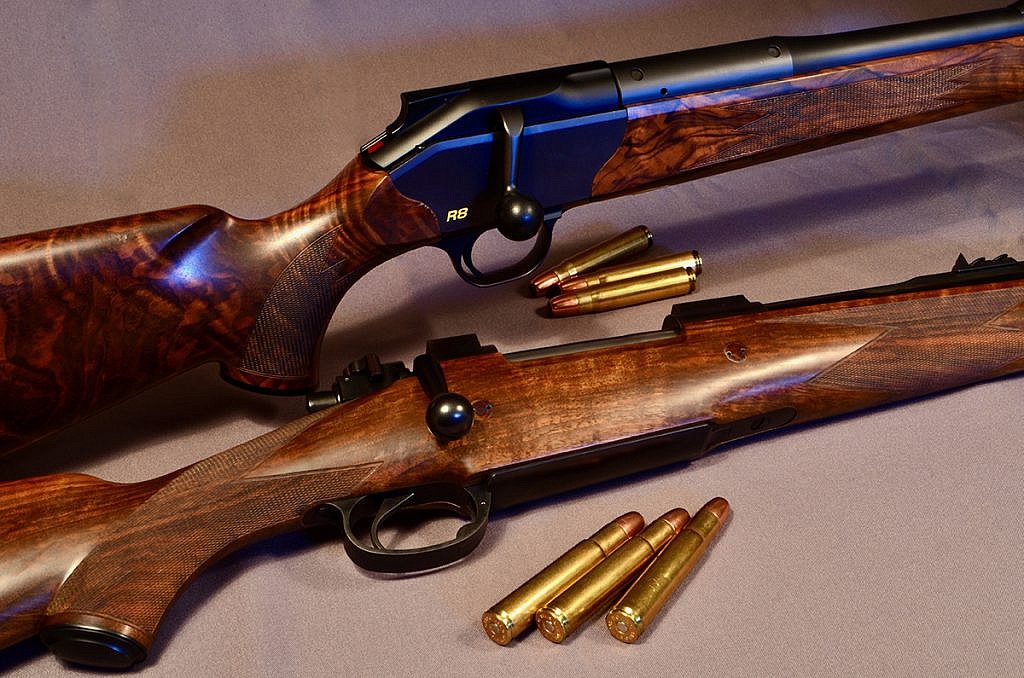
One of the more interesting heavy rifles I’ve hunted with was a 12-pound 8mm Remington Magnum built for Craig Boddington. I think Craig wanted something to use at long range, and if you use a powerful scope, heft is your friend. Craig shoots southpaw, as do I, and he loaned it to me on a nilgai hunt in south Texas.
As it happened, the shot I got required me to bend under a tree limb, so I was firing offhand, bent double at the waist, with the scope an inch from my eyebrow. This is the second worst position from which to shoot with a rifle that kicks (prone is the worst), except that due to its weight it didn’t kick, and the nilgai was hit fatally while my eyebrow escaped.
In 1990, I asked Kenny Jarrett to build a .338 with a heavy, 22-inch barrel. Loaded, with sling, it weighed 10 pounds, and it was distinctly muzzle heavy. But unlike some of my ideas, this one worked out spectacularly well,.
It became my designated elk rifle, because when you were gasping for air you could still hold it steady. The only thing it did not adapt to was prairie-dog hunting. The ammo cost a lot, and it spoiled a lot of meat.
We got into the lightweight craze because prior to CAD-CAM and CNC and all the wonderful synthetics now available, just about all rifles were much heavier than they needed to be. We did not have the technology to make them without the excess ounces. The sacred pre-64 Winchester Model 70 standard-weight rifle with a scope on board weighed 10 pounds, or sometimes more. The Model 70 Featherweight, which debuted in 1952, weighed two pounds less, which is just about right, but a featherwight it ain’t.
Jeff Cooper, who knew a great deal about shooting in the real world, wrote in 1957 that at the end of the day a seven-pound rifle (on a sling) cut into his shoulder just as painfully as a nine-pounder, but the nine-pounder was a lot easier to hold steady. Weight has its place on firearms, and some of them profit greatly from it.
Dave Petzal, when contemplating rifle weight, always keeps in mind the philosophy of Peter Barrett, former Executive Editor of Field & Stream: “If you can’t carry the god damn thing, what are you doing out there in the first place?”