by David E. Petzal
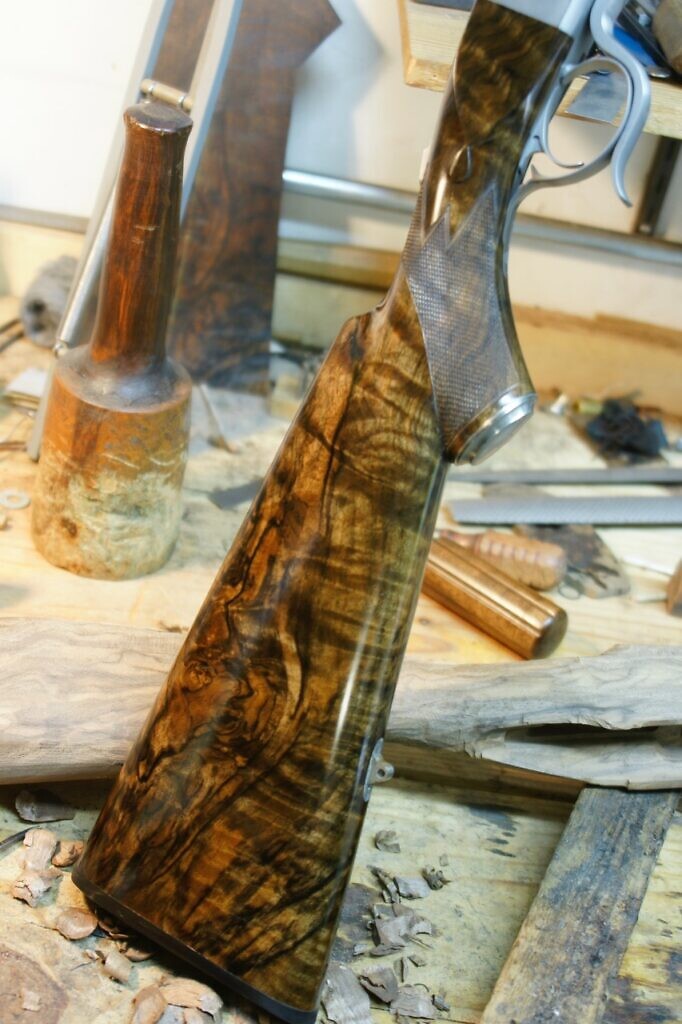
I dote on wood stocks. A really fine hunk of walnut is something that nature will never duplicate, and what it can be made into is a genuine work of art. But Lucifer lurks in wood, as do Beelzebub and Mephistopheles. Wood will work all manner of evil against thee.
The problem is that wood comes from trees and trees are living things, and even after you cut them down, saw them into blanks, dry them in the air and/or in a kiln, and finish them, their wood keeps on living, and living involves water. My friend Norm Nelson, a gun nut of purest ray serene who spent his life in the timber industry, said that a tree is a pump so powerful it can lift water from far underground to a hundred feet in the air.
Water causes wood to shift, squirm, shrink, and swell. Show wood water and it soaks it right up. Expose it to any extreme of climate and it will writhe and bloat and shrivel. When any of this happens, your rifle will change its point of impact, sometimes drastically. Consider:
- I had a .270 that, on more than one occasion, shifted its point of impact multiple times on the same hunt. Then, when I got it home, it would shift again.
- I had a restocked 7mm Weatherby magnum that was dead stable for six years until I took it to Africa where it was beaten up unmercifully and had to be refinished. Afterwards, it never held its zero again.
- I had a .375 H&H that was, from the get-go, so unstable it was unusable.
My favorite walnut horror story is of a .30/06 I was having built. The project was all set to go, and I was in the gunmaker’s shop when I noticed a fantastic French walnut blank standing against the wall. It was very dark and had wonderful black fiddleback striping. I had to have it. No, said the gunmaker, it’s already promised to someone else.
I wept. I groveled. I begged. Finally, just to get rid of me, the gunmaker agreed, and the result was a stock of sublime beauty, and also the most treacherous piece of wood I’ve ever encountered. It swelled and shrank in three different dimensions. It moved so much that sometimes I could not get the barreled action to fit into the wood. That wonderful piece of walnut was sawn up for knife handles. The guy to whom it was promised was told that, when his blank was cut into shape, all the figure vanished.
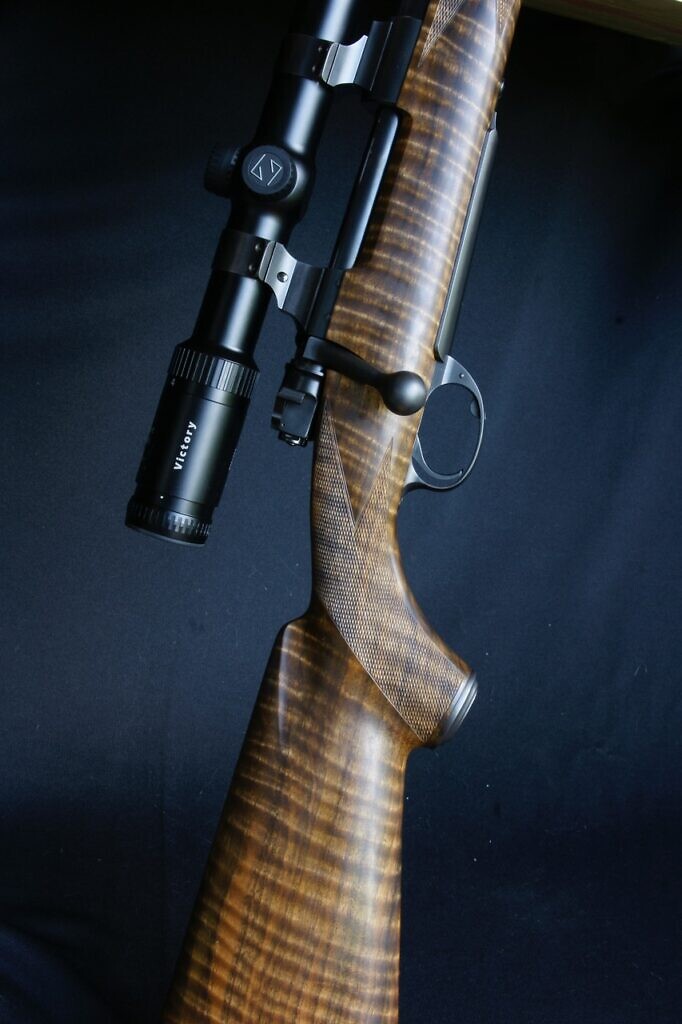
Wood stocks split and break. I had a restocked .300 Weatherby Magnum split behind the tang on an elk hunt. I’ve seen two Ruger Model 77s and a pre-64 Model 70 snap completely through the pistol grip. The Rugers cracked when the front sling swivel studs worked out and the rifles went flying off their owners’ shoulders, and the Winchester when airline ramp apes ran it over with a tug while it was in its case.
I saw disaster befall a .475 A&M magnum built in the early 1970s by a maker who had a great deal of experience with heavy rifles. Said cartridge was developed by the Prescott, Arizona, firm of Atkinson & Marquardt in the late 1950s, and is considerably more powerful than the .460 Weatherby. The people who made the rifle reinforced the stock with two crossbolts, set a steel rod up through the pistol grip, and welded a second recoil lug midway up the barrel. But on the first pull of the trigger, the stock split from fore-end tip to recoil pad. Wood, you see, has directional grain structure, and if you catch it just right, it’s like whacking a nice, dry log with a splitting maul.
When Roy Weatherby launched his terrifying .460 Magnum, he was well aware of walnut’s frailty and stocked his .460s in mesquite, which is like rock, but which is a nightmare to make into a gunstock. Inevitably, he had to switch to claro walnut. Just after the end of the Jurassic Era, I hunted in Zambia with a PH named John Knowles. John carried a walnut-stocked .460 as his stopping rifle. It had split, and was held together by Land Rover door bolts and marine epoxy. John told me his regular clients brought him stocks every time they came to Africa.
I can report that wood stocks are much better than they used to be. Gun makers have figured out how to bed a rifle so it holds its zero pretty well. Finishes are much better at keeping out water. The good old days of spar varnish overlaid with linseed oil are long gone.
The real improvement in wood is laminates. The idea is not new but the technique used to make it has changed radically. It formerly consisted of gluing together chunks of different woods that were roughly as thick as a building brick. Not only was the result heavy, it was not especially stable since there was so much wood used. Now, laminated wood is made by taking very thin slices of wood and fusing them together, using resin as the bonding agent, under tremendous heat and pressure. The wood is impregnated down to molecular level; the result is hard as flint and unshifting and unchanging as the average pyramid. The AK-47, that paragon of indestructibility, used laminated birch for its stocks. I have used three laminated-stock Ruger Gunsite Scout rifles under really lousy conditions, and they refuse to budge.
The drawback is, of course, that they look like laminated wood. So what? John F. Kennedy said that life is unfair, and that extends to stock wood. And, of course, there are walnut stocks that not only look sensational, but are reliable as sunrise. If you get one, bind it to you with hoops of steel.
Dave Petzal believes that one of the most wondrous experiences in all of gunnery is that moment when a piece of walnut that has been shaped and sanded as smooth as marble feels the first touch of stock finish, and all its colors leap to life.