by Terry Wieland
As you might have read here, in a note by Dave Petzal, the rifle world lost one of its prominent citizens in early June when Melvin Forbes died of cancer. Melvin was the founder of Ultra Light Arms and, as a rifle designer, had an influence far out of proportion to the size of his company.
Alas, Forbes was not alone. Two other noted riflemen also died recently—writer Mike Venturino and, early this year, Tom Turpin.
In a way, each represented an era in the world of rifles: Forbes with ultra-light, ultra-accurate guns using synthetic materials, Venturino with the renaissance of interest in black-powder cartridge rifles and buffalo guns, and Turpin with gilt-edged, custom, bolt-action hunting rifles.
I was acquainted with all three men and admired their accomplishments. Melvin Forbes’s redesign of the Remington 600 action to create a rifle that was light in weight by design, rather than by trimming and scraping wherever steel could be spared, influenced the entire industry because it changed the expectations of, particularly, mountain hunters who carry their homes on their backs and demand top-notch performance combined with minimum weight.
Having done my share of hunting in the mountains, including backpacking, I could certainly see the attraction.
Then there was Mike Venturino. Mike moved in circles that I, largely, did not. His was the world of long-range, black-powder target shooting with the ancient buffalo rifles of the old west. In fact, journalistically, Mike made it his own niche.
Venturino was one of two men I know (Ron Spomer being the other) who set out from the beginning to make a living writing about guns and hunting. Mike finished college in West Virginia, moved to Montana in the early 1970s, and never looked back.
While he published a great deal in various magazines over the course of more than 50 years, in terms of longevity (both influence and reputation) what really counts are books. Three of Mike’s that are particularly good are Shooting Buffalo Rifles of the Old West, Shooting Lever Guns of the Old West, and Shooting Sixguns of the Old West.
Each is essential reading for anyone interested in those guns, and who doesn’t have a soft spot for buffalo rifles, lever actions, and sixguns?
***
Of the three men, my closest relationship was with Tom Turpin. Tom and I shared an interest in custom rifles and shotguns, and for years we teamed up to see the American Custom Gunmakers Guild (ACGG) show, held in Reno simultaneous with the SCI convention. For years—decades!—Tom put together the custom-gun section for Gun Digest. He knew everyone who was anyone, and they all knew him.
Tom had about ten years on me, which was long enough, in the business, for him to have known John T. Amber personally, as well as such custom-rifle luminaries as Al Biesen. He was close friends with Don and Norma Allen, founders of Dakota Arms, and several times we visited Dakota’s operation in Sturgis.
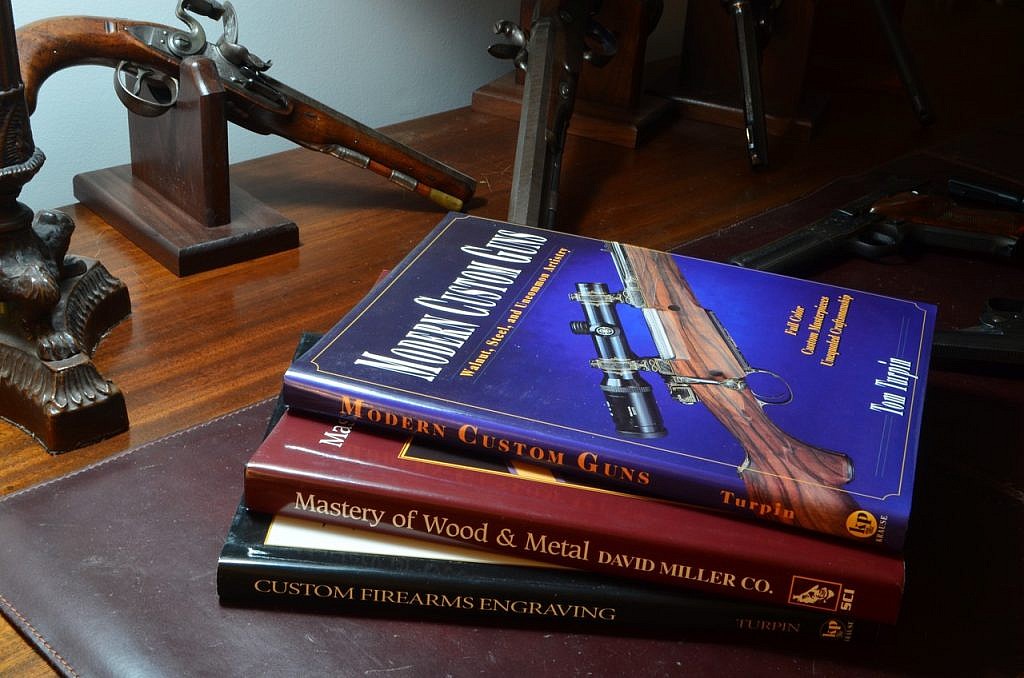
Tom wrote three books on custom-rifle building: Modern Custom Guns, Custom Firearms Engraving, and Mastery of Wood & Metal—The David Miller Co. He firmly believed that such rifles—even a $50,000 breath-taker from David Miller—were meant to be shot, and hunted with, and shot some more. Tom being a dedicated hunter and shooter, he did exactly that. Whether he did so with every one of the custom rifles in his collection, I can’t say. Nor can I say exactly how many he had.
Between the years 2000 and 2015, it seemed to me that he had at least one, and usually two or three, rifles under construction at any given time. I visited his home in Sierra Vista once, and got a tour of the vault and gun room, and all I can say is, there were a lot of rifles. A lot! Most were bolt actions, Tom being a devotee of the pre-64 Model 70 and the classic Mauser 98, but there were others as well.
It’s interesting to look back on the years from 1990 to 2020, in light of the deaths of Forbes, Venturino, and Turpin. It would be overstating to say that each represented an era, and that their eras passed away with them, but to a certain extent it’s true.
The shooting world, like any other world, has fads and fancies. Fashions come, prices are driven up, fashions pass, prices come down. Usually, they don’t pass completely, since a core of devotees is usually left behind to keep the torch burning.
Think of sporting clays, cowboy-action shooting, silhouette shooting, the passion for side-by-side doubles, American and English, and big-bore double rifles, or the rise of the super-exquisite custom rifle where afiçionados examine the checkering with pursed lips and a magnifying glass.
Often, the fad passes because the devotees grow old and die, and their descendants have no interest. Other times, products price themselves out of the market. And in still others, they are overtaken by technology that renders what went before either obsolete or outclassed.
In the case of custom hunting rifles, for example, it seems to me that the twin factors of a prima-donna attitude and soaring prices have combined to put paid to the world Tom and I admired back in 2010 at the ACGG show. And then there’s the question, where will the skilled gunsmiths come from who might carry it on?
These are not particularly cheering thoughts as one reflects on current events, and not just in the gun business. Still, my three friends mentioned here each made a valid and, I believe, lasting contribution to a world we all cared about very much.
One of Tom Turpin’s tastes Wieland never shared was his ritual Wednesday breakfast of biscuits and gravy. You can take the boy out of Kentucky…