by David E. Petzal
Melvin Forbes, of Granville, West Virginia, departed this earth on June 5th at the age of 77. In 1985 he founded Ultra Light Arms (after 1999, New Ultra Light Arms) and was one of the handful of men most responsible for the radical transformation of the American hunting rifle. He and I had been friends since the summer of 1985 when Ultra Light was just getting started, and hunted together twice a year for the next 20 years.
He started calling me “Sir David” at some point, possibly because I come from the landed gentry, or perhaps because of my aristocratic mien. I pointed out to him that what I did for a living was the small dust of the balance, and that my drivel would be forgotten a week after my demise. But building rifles was real and permanent, and that a century from now, people would still be shooting ULAs and NULAs, and marveling at what he had done. Therefore, he outranked me in the Peerage, and I addressed him as Lord Melvin.
Melvin was a West Virginian in his very bones, and looked the part, and you would not mistake him for a member of MENSA. But he was a genius, mechanical variety. He knew how everything worked. If it didn’t work he knew how to fix it. And he knew how to make it so it would have worked in the first place. His talents were limitless, as far as I could see. He could operate a backhoe like a pro. He could (and did) build a house, and everything in it functioned right out of the box. He once took a couple of computers out of his pickup because they displeased him, adjusted them so they made him happy, and put them back.
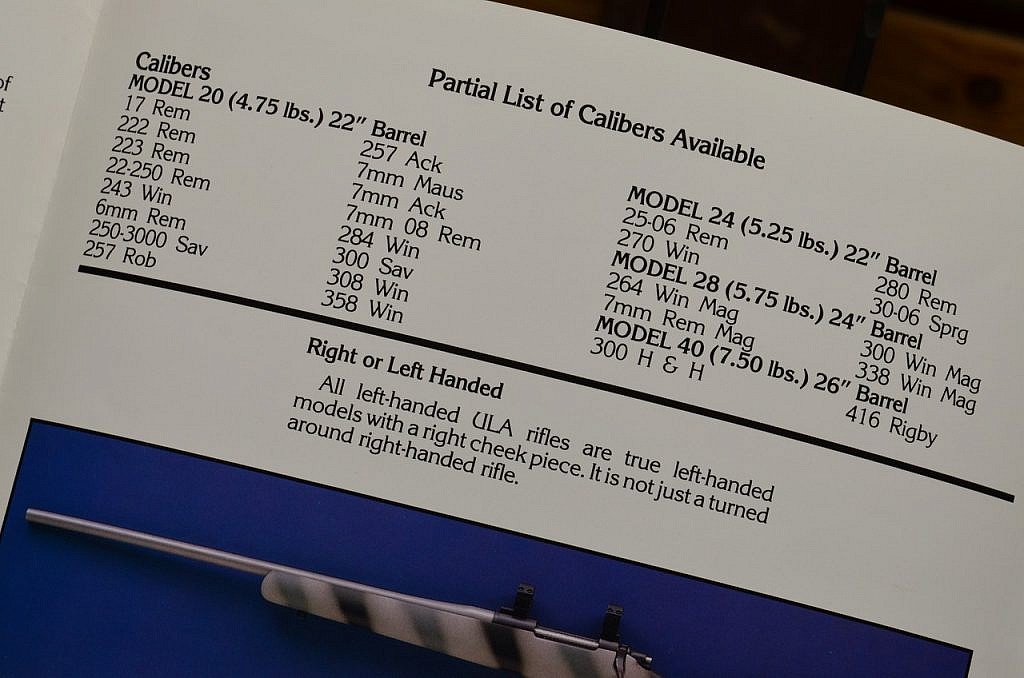
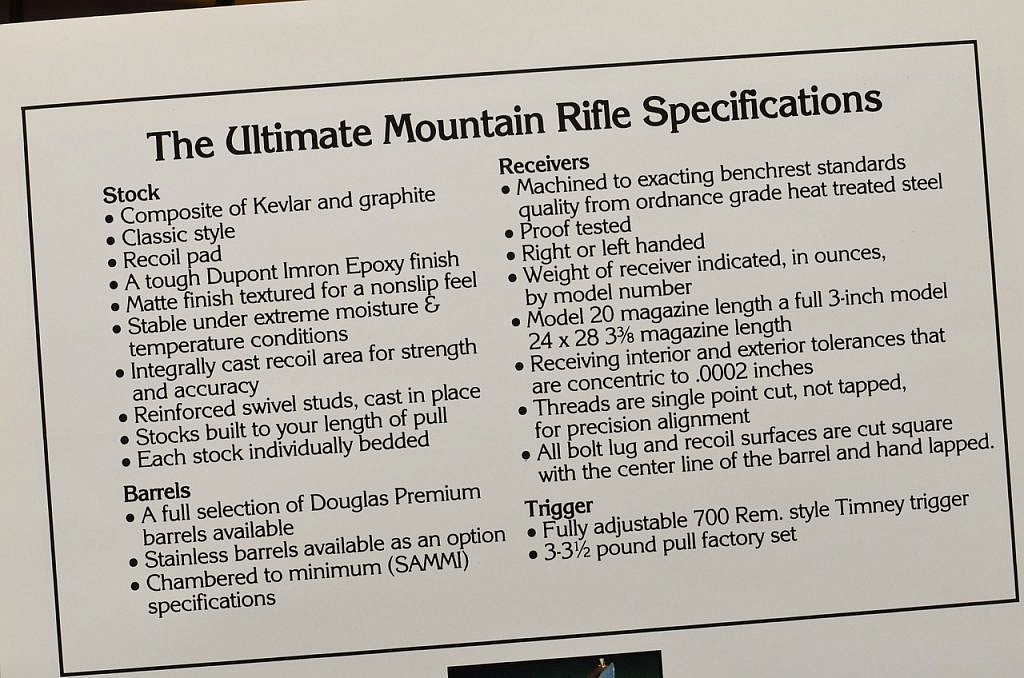
ULA specifications, 1996. These were ground-breaking at the time, and would still be competitive today.
He told me that he could keep the schematic for a Browning Superposed action in his mind as he rolled over it with his mental pointer. Out of curiosity, I asked if he could make me a Gibson Granada Flathead 5-string banjo like the one Earl Scruggs played. This was completely alien technology to him, but he paused, considered how a banjo must work, and after a little reflection said, “Yes, I could.”
Melvin came from a tradition of unschooled talent. Jim Carmichel once pointed out that the hills and hollers of the Smokeys and the Blue Ridge Mountains are filled with people who look at something subtle and complex, like a flintlock rifleor a guitar, say “That don’t look so hard,” and make the thing themselves.
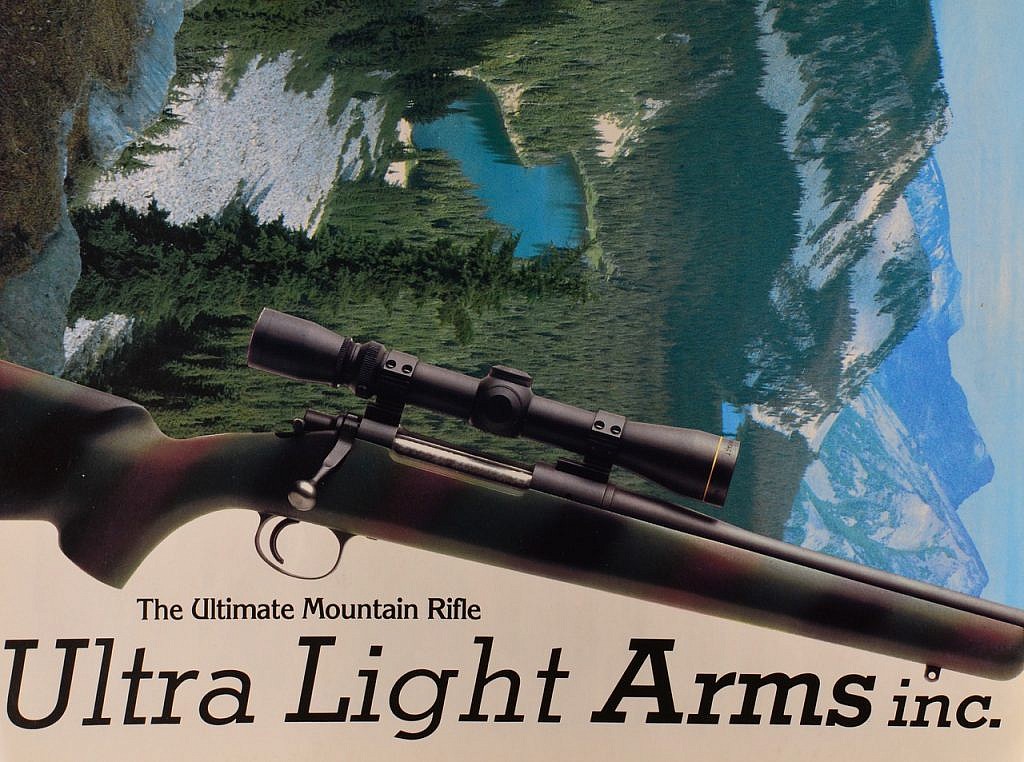
In designing what became the Ultra Light Arms Model 20, Melvin had help from the aerospace industry. His goal was to create an unchopped, unbutchered bolt-action rifle that weighed no more than six pounds with scope. No one had attempted anything like this that worked. A lightweight big-game rifle in the early 1980s was a standard gun that had been mutilated to where it weighed eight pounds with scope. Everything was hollowed, scooped out, and skeletonized.
As his starting point, Forbes used the Remington Model 600 carbine because it contained the least fat of all the rifles he could find. He realized that much of the problem lay in the stock. Wood would not do in any form, and the few synthetic stocks around were fiberglass and not much lighter than wood. However, he had a shooting friend who was an authority on high-strength fabrics, and another who knew all there was to know about space-age adhesives. This troika came up with a stock that was not only a sensuous delight, but weighed one pound even. It was made of Kevlar and graphite, and was so strong you could run it over with a full-size pickup and do no more than scratch the paint. It was so rigid you could try to pull the barrel up out of the fore-end, and the barrel would bend, and nothing else.
Forbes knew that stress not only kills people, but accuracy as well. His actions are bedded on aluminum pillars (which hardly anyone else used at the time) and everything else just touches. There is no stress in his rifles. They’ll never go weird on you because they can’t. As an experiment, Melvin once took a new NULA out of the rack and sighted it in. He then:
- Took the scope out of the rings. (The rings were his own lightweight design. They’re now an industry standard.)
- Took the bases off the receiver.
- Took the barreled action out of the stock.
- Unscrewed the barrel from the receiver.
Then he put everything back together. The rifle shot to exactly the same point of impact.
Were they perfect? No. I owned 10 NULAs at one point (and paid for them, too) so I speak with some experience. Anything that light is going to be twitchy, and I found that if I used #2 or #3 contour barrels instead of Melvin’s #1, they held a lot tighter. Also, his rifles kicked. I owned a NULA in .340 Weatherby that was not only very accurate, but lucky as well. It was also a ferocious kicker, and as the orthopedic surgeon told me, “If you don’t stop shooting that thing I’m going to be able to buy a new Porsche.” I sold it.
Looking back, I’ve owned NULAs in .22 Long Rifle (a couple), .220 Swift, .270, .280, 6.5×55 Swede, 7×57 Mauser, .30/06, 7mm Weatherby Magnum and .340 Weatherby Magnum. The most versatile was the 7mm Weatherby, which wore a #4 contour barrel (and caused Melvin great pain) and traveled from the Texas brush country to eastern Wyoming to the yowling wastes of Quebec’s Ungava Peninsula, and slew everything along the way. My favorite was the 6.5 Swede. I took heaven knows how many deer and antelope with it, and it had no kick.
I should add that Melvin was an honest man, a decent cook, a great friend, and skinned all my deer because he couldn’t bear to watch me do it. He built 2,000 rifles, and he loved them each and every one. He once picked up my 6.5 Swede, looked at it with tenderness, and said, “The people who send me money for these think they’re buying them. They’re wrong. They’re just renting. These rifles will always be mine.”
Dave Petzal, upon seeing his first Ultra Light at the 1985 SHOT Show, held it in his hands and said, “Nice cut-down Remington.” Melvin Forbes, instead of throwing him out of the ULA booth, sent him one to try out.