Is it better than either of those? No. Worse? No, again. But it’s different and, in some ways, offers advantages the others don’t. It can utilize light bullets better than the .375, and heavy ones (up to 300 grains) better than the .338. It’s really just a matter of what you prefer.
In 1989, I took a custom-made .358 Norma to Texas to hunt nilgai, the notoriously tough “blue bull” of India transplanted to the King Ranch in the 1930s. Some authorities insisted you need at least a .375 for nilgai, and a .416 Rigby was better.
With my .358 Norma, loaded with Jack Carter’s then-new 250-grain Trophy Bonded Bear Claw, I got a shot at 80 yards, planted the bullet behind the shoulder on the left side, it struck the inside of the right shoulder, knocked the bull off its feet with an audible thump, and it never moved a muscle. Our guide said he’d never seen that before, which I offer for what it’s worth. (Guides are prone to saying things like that, with an eye on their tip to come.)
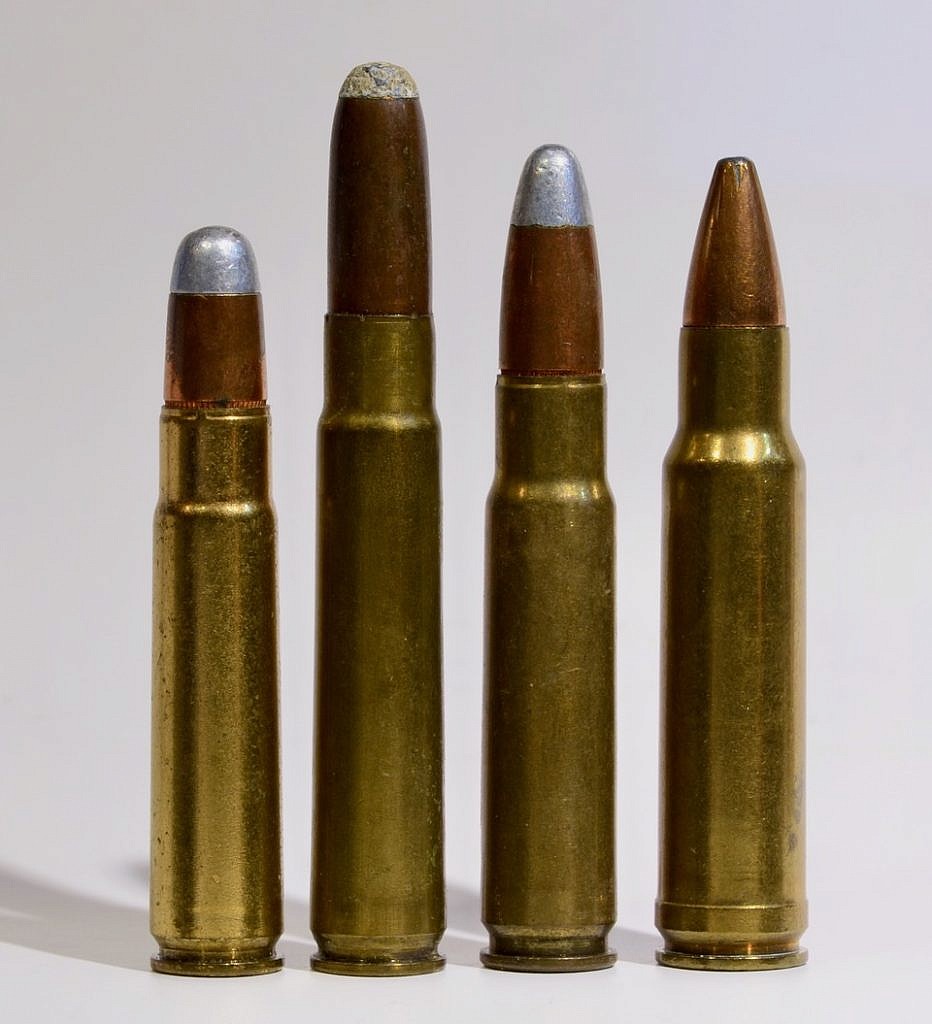
Europeans have their equivalent cartridges in 9mm (.356) and 9.3mm (.366), and many have been quite successful—most notably, the 9.3x74R, a rimmed, straight-cased round similar to the .375 Flanged. But others range up and down in power. The 9×57 Mauser, 9×56 Mannlicher, and 9.5×57 Mannlicher, are all very similar to the .358 Winchester in performance. They may not be spectacular, but they are quietly competent.
I should point out, too, that one advantage of a .35 is that it will push a bullet of equivalent weight to a higher velocity than the same bullet in .308, simply because there is more base area for the expanding gases to push on. My .358 Norma will launch a 180-grain bullet at 3,200+ fps with no sign of adverse pressure. Try getting that out of a .30 of the same case size.
This is the same advantage the big .450s enjoy over the .416s: A .458 Lott will easily match the velocity of a .416 Remington’s 400-grain bullet, in a smaller case, without breathing hard.
In both instances, this is a short-range advantage—out to 200-250 yards— but neither a .450 nor .350 is likely to be called upon as an ultra-long range round. Although—and I can hear the .35 enthusiasts leaping to their keyboards—it must be said that the .358 Norma enjoyed a modest reputation as a police-sniper and tactical cartridge in the 1960s and ‘70s.
Dick Dietz, who was Remington’s main flack years ago, once opined that as one got older, one liked his “wine drier, his steaks rarer, and his bullets heavier.”
Along that line, it’s been my observation that the main admirers of cartridges .35 and larger are men 35 and older. There’s a message there.
Having fallen for the .35 Remington at the tender age of 15, Gray’s shooting editor Terry Wieland has a modest claim to being ahead of his time. Or, looked at another way, being old when he should have been young. You decide.