There are places, Maine for example, where there’s a strong blue-collar tradition, but most still think of Atlantic salmon fishing as the Sport of Kings and associate it with private clubs, enforced gentility, fine tackle, single malt scotch, and good cigars. There’s a story that the Bomber fly was invented on the Miramichi River in New Brunswick when a wealthy sport tossed a cigar butt into the river and a salmon ate it. You assume it was an imported La Gloria Cubana instead of a rum-soaked crook bought at a gas station.
All things being equal, a good Atlantic salmon fisherman will do well on a steelhead river because the ground rules are so similar, but the fishermen have a more rough-and-tumble reputation and he may find himself wondering if these people are entirely housebroken. Good cigars aren’t unknown in steelhead camps, but it’s just as likely that instead of passing out Cubans, a steelheader will toss a Ziploc full of marijuana into the guides’ shack the way you’d throw raw meat to a cage full of hyenas.
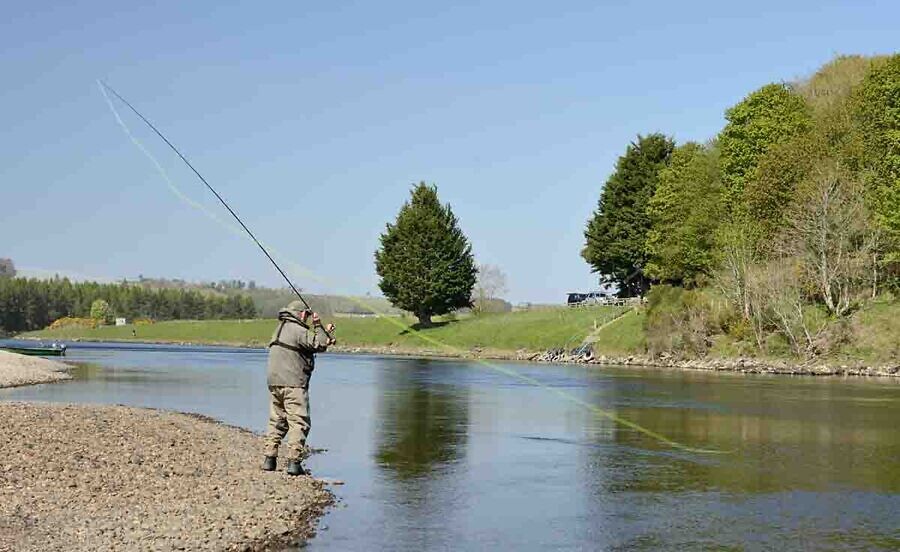
I’ve spent the last decade or so lagging behind the advancing technology of steelheading, not so much to be a Luddite as to strategically ignore the hot new thing until it either runs its course as an expensive fad or becomes standard practice. I learned to cast two-handed rods with full floating lines and tapered leaders, and that’s still my favorite way to do it, but there are too many times when you have to reach right down to the gravel to find fish. For that, most now use an assortment of Skagit heads and interchangeable tips of different lengths and sink rates that can be fine-tuned on the spot to achieve something approaching perfection. I was leery of these shooting heads for a while, then cautiously tumbled for them when they refused to go away. At first they felt as heavy and sluggish as lengths of wet rope, but in time my casts became crisper and more compact, my running line began to snake through the guides with a satisfying hiss, and my flies dived to the bottom like depth charges. Welcome to steelheading in the 21st century.
A mind-numbing array of this stuff is now available commercially, but some Spey wonks aren’t satisfied with any of it and spend hours in their basements with grain scales, scraps of line, razor blades, shrink tape, and heat guns, building their own heads. You can spot these guys on the river by the way they scowl appraisingly at every cast, while back at the lodge their conversations run to lengths, grain weights, loop construction, and the arcane business of “cheaters.” Steelheaders spend an inordinate amount of time and effort perfecting their casts because that’s the only part of this they have any control over. I catch myself admiring their restless dedication even as I try to reduce my own level of fussing to something more minimal.
We’d been told that the word had spread about this river since the last time we fished it, and there was some evidence of that. It wasn’t exactly mobbed, but there were more cars on the canyon road, more fishermen in the general store every morning stocking up on coffee and breakfast burritos, and more drift boats on the river. Some, including those rowed by the guides from the lodge, would pass us on the inside in order to leave the runs undisturbed, while others would just pound beads and bobbers through our water, acting as if they hadn’t seen us. Anadromous fish engender an insane devotion and, often enough to mention, the kind of self-importance that trumps manners. Maybe it’s just human nature, or maybe it’s zoology: a case of too many mammals competing for a limited and dwindling resource.
Once, on a famous steelhead river, some friends and I launched a drift boat in the wee hours, hoping to be the first at an especially promising run. We made it, and for the next hour boats passed in the near dark and locals made rude comments about us and our mothers, maybe not realizing how well voices carry across water. But I’ll take snubs and insults over the two guides in Alaska who recently beat each other senseless over a pod of king salmon while their sports stood by helplessly, wondering if this was part of the incomparable wilderness adventure they’d been promised.
One night after dinner, the owner of the lodge, Jack, found us out back with the guides and dogs and asked if we wanted to do a float through the canyon the next day. Were there fish up there? No telling, but we’d been pounding the lower river for days on the assumption that whatever steelhead were in would be stalled there waiting for the spate. We’d seen lots of other fishermen with the same idea, but no action.