Inside, it was like happy hour at a sports bar, with the same first-drink-of-the-night boisterousness as well as the perpetual football game turned up too loud on a 60-inch TV and sucking the oxygen from the room. And later, after a few more drinks, you’d overhear the same snatches of mismatched conversation where one guy declares, “I think Glenn Beck is a genius,” and someone else replies, “You mean Jeff Beck, right? The guitar player?” We realized that we had the rare opportunity here to cherry-pick the best of lodge life and deftly sidestep the rest. So after sponging a good meal we didn’t have to cook for ourselves, and picking the brains of the guides, we’d yawn theatrically and head back to our quiet, empty house down the valley.
Steelhead—along with Atlantic salmon, the five species of Pacific salmon and sea trout—all fit the unlikely profile of ocean fish that are born in freshwater rivers and return there to spawn, or river fish that spend much of their lives at sea, depending on how you look at it. It’s an elaborate and risky adaptation (a hundred smolts can leave the river for every adult that survives to spawn) but it makes sense as an evolutionary blueprint. There’s more food in the ocean than in the river, so the fish grow bigger, and the biggest fish claim the best spawning habitat and lay more eggs, thus ensuring the survival of the species. In this unforgiving system, reproduction is the only criterion for success.
Sea-run fish don’t actively feed when they return to the rivers to spawn. The result is that they don’t gobble up the parr from previous runs and decimate their own species, but no one seems willing to say that’s why they don’t eat. I once asked a why question in a college biology class. The professor said, “Here we talk about ‘how;’ if you want to know ‘why,’ you’ll have to go over to the philosophy department.” He pointed vaguely in the direction of the Humanities Building to show that he wasn’t kidding.
I hate being hungry, so this idea of months of hardship without food haunts me. But then salmon are said to undergo physiological changes that may keep them from wanting to feed, which makes me feel better. Also, stomach sample studies suggest that at least some steelhead secretly snack on the odd stonefly nymph or caddis pupa, and the whole business of fishing orange plastic beads for steelhead presupposes that they’ll eat chinook eggs. That makes me feel a little better, too.
Some of these migrations are epic. Steelhead that entered salt water on the West Coast have turned up over 2,000 miles away in the Sea of Japan. Scientists think these fish navigate the open oceans using the magnetite deposits in their nasal cavities. No one seems to understand how they do it, but why else would you have a magnet in your nose?
And later, after a few more drinks, you’d overhear the same snatches of mismatched conversation where one guy declares, “I think Glenn Beck is a genius,” and someone else replies, “You mean Jeff Beck, right? The guitar player?”
The farthest inland I ever caught a steelhead was in the Salmon River in Idaho, some 900 river miles from the ocean. It was a big wild hen with old net scars and a half-healed seal bite. Before I landed her she got me in fast water and almost cleaned my clock, even though she might have traveled 3,000 miles and hadn’t eaten in the five or six months since she’d entered fresh water. Fishermen claim to love the sea-run fish for their size, but what we really love is the unimaginable size of their lives.
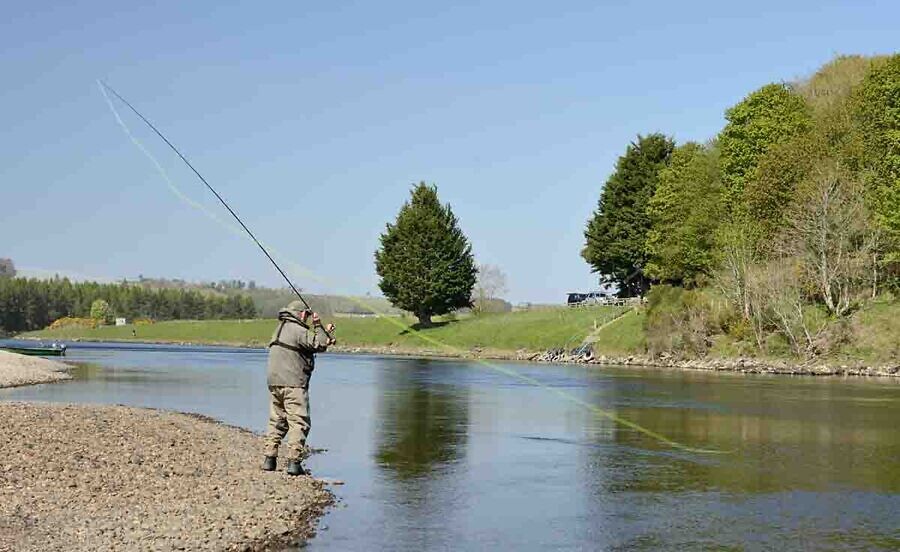
These fish have a way of raising the bar. Their elusiveness makes each one seem fraught with significance, and a cult of seriousness has grown out of the number of hours, days, or weeks that can pass between hookups. There’s plenty that can go wrong without making a dumb mistake, so fresh leaders are bought before every trip, knots are tied with exaggerated care, hooks are sharpened to surgical specifications, and favorite flies take on religious significance. It’s widely believed that over time, steadiness and diligence are rewarded, but it’s also known that luck in steelheading is unevenly and unfairly distributed, so that creeps and blowhards land more than their share.
There are lots of crackpot theories about when, how, why and what sea-run fish will bite when, by all rights, they shouldn’t bite at all, but over the long haul, none is so reliably productive as the one that says you should just keep a hook in the water. And although the tackle, tactics, and sometimes even the odd fly pattern will translate among species, the subcultures that have grown up around the various fish have stayed unique.