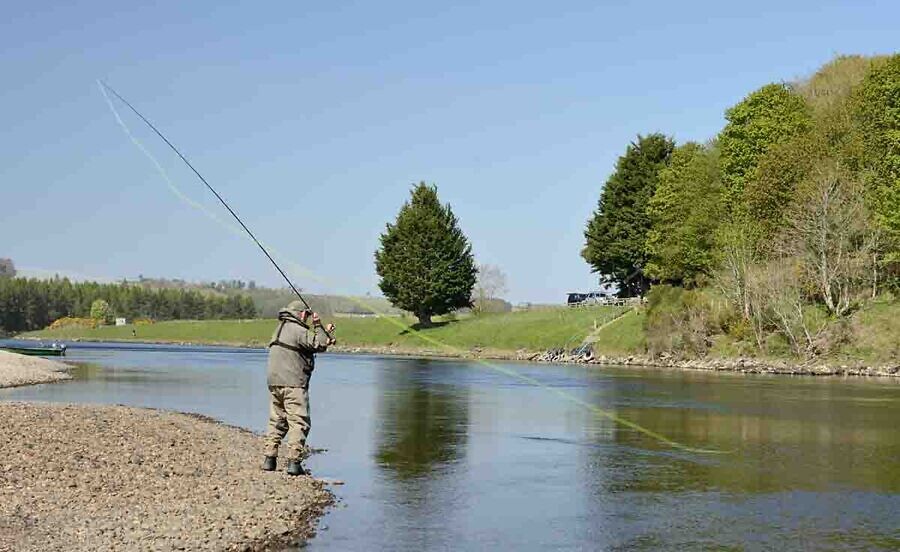
Ordinarily, in the city, he didn’t miss it a bit, but that once a year, he’d put on his hat, and climb into the river and look at his guide and look at the wilderness, and something inside him would stir, and he’d think: What if?
When you’re guiding, you’re standing back, you’re looking up, you’re fishing, but not quite. The stream was narrow, not much more than a stride or two across. There was a pool, deep for the scale that made it about three feet deep, and there was a brisk flow coming into it.
“What about this?” he asked, showing me an Adams in a size 14.
“Give it a try,” I said. There were some olives coming off—Baetis rhodani, I think (so some of it must stick)—and an Adams should do the trick here as well as anything.
It wasn’t the easiest of presentations—under goat willow, into a fast flow, and through to a small window of opportunity. He tried a few casts and fluffed them. “Here,” I said. I took him aside from the pool and showed him the basics of the side cast. He picked it up quickly, relearning I thought rather than starting afresh. We went back to the pool.
“Put it in right at the top, as close into the flow as you can, and be ready,” I said.
I knew there was a fish there, I’d seen it rise and take an olive from the surface a few minutes prior, and I knew this river, and I knew if that fly drifted over right, it would go.
But the fly was getting caught in that current, and the tippet was dragging it like a bow and making it skitter across the water. He could stand there doing that all day, and he wouldn’t catch that fish.
I could see he was getting frustrated. I don’t know what it was, but he had invested something big, some part of himself, in that fish.
“Do you mind . . . ,” I asked, “if I offer you a few ideas?”
He stopped and turned.
“Please do,” he said.
His eyes beneath that old felt hunting hat implored me. The faintly ridiculous, when carried with confidence, can look characterful, but right then, for that moment, he looked like an old man in a daft hat, trying to catch something that had long gone and existed only in memory, what I don’t know, maybe that wife.
“Guys like you,” he said, “guys like you practically live out on these rivers. You live and breathe the rivers. You know them. That is what is so helpful to guys like me. I need that. So please do.”
And I did; I owed him that. I knew he needed me to be that figure, that old man of the river. And I realized right then that while I might not know the name of everything and might not be able to spit gravel, I do know the feel of the river, the smell of it, how the different shapes work together and come together, and I knew that he needed to put that fly at the head of the run with a bit of slack and get that drift right, and once that fly started to skitter it was game over for that run so pull it off and make another cast a little farther along that pool, inching your way along, until that little trout is fooled in the slack and takes it.
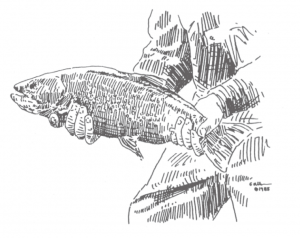
That trout was no more than 10 inches long, but he held it beneath the hat and beneath a grin of such delight that said holiday was over for another year, like a mission, like a pilgrimage and he could have been a contender, but it was time to go back now. Time to go back.
I CLIMBED OUT OF THE RIVER MARGINS AND BRUSHED AT THE DAMP PATCH THAT WAS STICKING TO MY KNEE. The dipper was bobbing on a stone breaking the middle of the river and in its own luxuriant covering of moss. I walked downstream slowly, in the shadows of the cover of the alder and hazel, Alnus glutinosa and Corylus avellana, respectively (I just looked that up), but I was starting to focus in the water.
I caught the dark shape of the side of a trout finning in the stream. It started to move up through the water, toward me, and I stopped, hardly breathing. I thought it was going to take a fly from the surface, there were some midges, but it didn’t take and paused an inch or two below—a good fish, too. We both hung there. Then it slowly fell back down into the deeper channel in the center of the river, a shadow going back to the night.
The peregrines flew against the sky at the tops of the crags, kek kek. The waterweed glowed emerald and flowed in the current like long locks of hair. I turned, the tips of my forefingers rubbing against the flats of my thumbs, impatient, and started to walk back, brisker now. It was time to go fetch a rod.
Andrew Griffiths is a writer and journalist based in England’s Peak District. He writes about angling and the environment for UK newspapers and magazines, and loves to fly fish the small rivers of Derbyshire for wild brown trout. It never ceases to amaze him how the smallest flies catch the biggest fish.