But Akbar, in particular, also used such expeditions as opportunities to meet local Sufi saints and Hindu holy men to discuss theology, or to exchange novel gifts with his Persian or Rajput rivals; these included mechanical “Huntress Diana” clockworks by esteemed Augsburg goldsmiths, as well as trained cheetahs and elephants, and exotic birds. Jahangir used such outings to also carefully document the flora and fauna of his realm.
In preparation for qamargah, scouts studied the lay of the land, locating obstacles and pockets of game. Simultaneously, they did field reconnaissance for possible skirmishes, should any local upstarts need reminding of who was in charge. Then an army of beaters would drive the game, from up to 60 miles away, into the 10-square-mile fenced or netted circle that would slowly tighten. In Babur’s Battle of Khanwa (1527) against the Rajputs, he successfully used this taulqama or pincer movement, his flanks encircling the enemy and gradually squeezing them while shooting into the center.
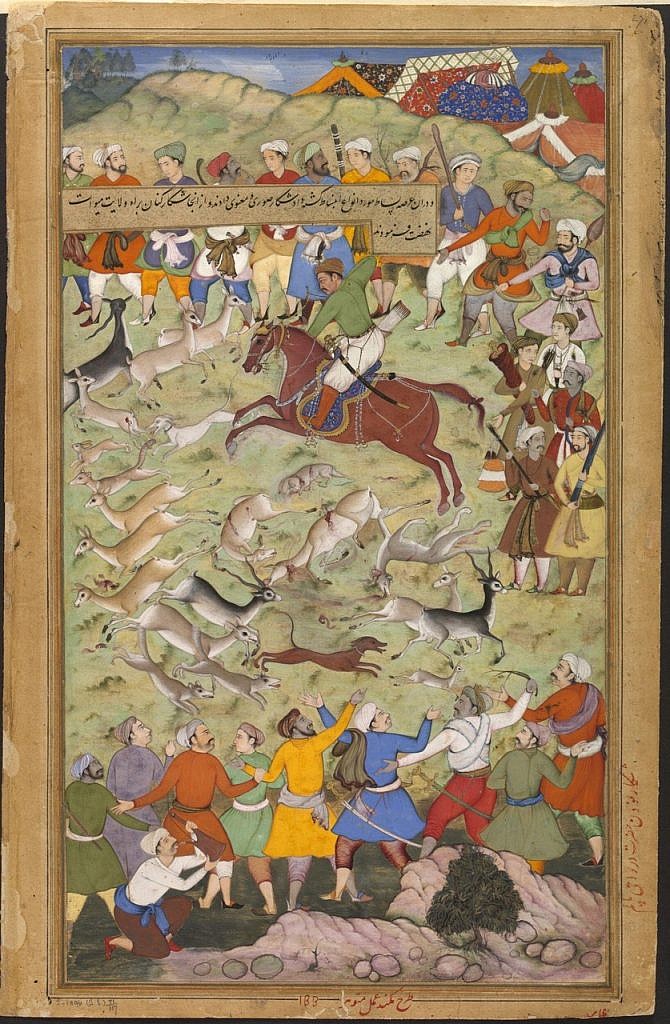
One miniature of a qamargah shows the valiant Akbar on horseback, dominating the landscape by slaughtering its wild animals, evidence of his unimpeachable power over nature. The hunting enclosure is his battlefield, and he charges into the frenzied battle of blood and chaos, unleashing his trained cheetahs.
After proving his own prowess, the emperor allowed his princes, grandees, and honored individuals from the army, to finish the slaying to demonstrate their warrior-like equestrian and combat skills. This included the Parthian shot, which requires the rider to twist his torso around to shoot his bow behind him. With 15,000 animals killed, Abkar’s shikar has been called the greatest hunt ever.

One time, as depicted in a miniature, in the middle of qamargah, while looking where his quarry lay, Akbar had a vision that caused him to stop the hunt and distribute gold to beggars and ascetics instead. Another time he fell into a trance while hunting wild ass in the Punjab. Such mystical revelations led him to occasionally stop hunting or eating meat, a tradition carried out by Jahangir. Refraining from meat also served to show deference to their Hindu subjects. But to get around any promises to abstain from hunting, he simply unleashed his cheetahs, or took along his favorite wife and counsel, the influential Nur Jahan, and she pulled the trigger. Nur Jahan once killed four tigers from elephant back with six bullets, although there are no testifying miniatures to prove it.
To be cont’d…
Brooke Chilvers was surprised to find one of the finest collections of Islamic art and artifacts, in Copenhagen, Denmark. Founded by lawyer and businessman C.L. David, The David Collection is open to the public in an exceptionally informative museum.