by Brooke Chilvers
Picture in your mind the artwork you associate with the Château de Versailles during the lives of King Louis XIV (1643–1715) and his mistresses, the Marquise de Montespan with whom he fathered seven children, then Madame de Maintenon, whom he married in secret after the death of his neglected wife; and of Louis XV (1715–1774) and his ladies, the style-setting Madame de Pompadour who died in 1764 at Versailles, and then Madame du Barry, who would be guillotined in 1793 during the Terror.
Jean Siméon Chardin’s (1699-1779) sober, potent realism, his harmoniously colored still lifes, composed from his own modest household objects, or of game birds, hares and rabbits, are probably the last paintings that conjure up 18th-century French Rococo art.

One thinks instead of Jean-Honoré Fragonard’s (1732–1806) cloaked hedonism, his frivolous, blue-blooded ladies swinging carefree through the Eden-colored air. In fact, most of Fragonard’s 550 paintings convey the courtly decadence and wild flirtatiousness during the pleasure-loving last decades of the Ancien Régime before Neoclassicism moved to center stage. The aristocracy that had followed Louis XIV to Versailles were the artist’s flattered followers, for he portrayed their stylish naughtiness with great charm, making looking up a woman’s wind-blown ruffled skirt an act of gallantry. Madame du Barry favored Fragonard, but he lost her patronage when the former Paris courtesan was banished from Versailles upon Louis XV’s death and sent to a convent in Meaux.

Jean-Antoine Watteau’s (1684–1721) idealized landscapes and voluptuous aristocratic adventures in his Fêtes galantes, or “courtship parties,” appear to celebrate the lifting of the constraints imposed by the Sun King’s pompous and ceremonious court at Versailles. They are an invitation to chivalrous seduction, making female resistance to male advances more erotic than giving in; here, tender gestures camouflage seduction. Watteau’s saucy garden parties also appealed to rulers the included Frederick the Great, King of Prussia, but taste for such works was shattered by the 1789 French Revolution.
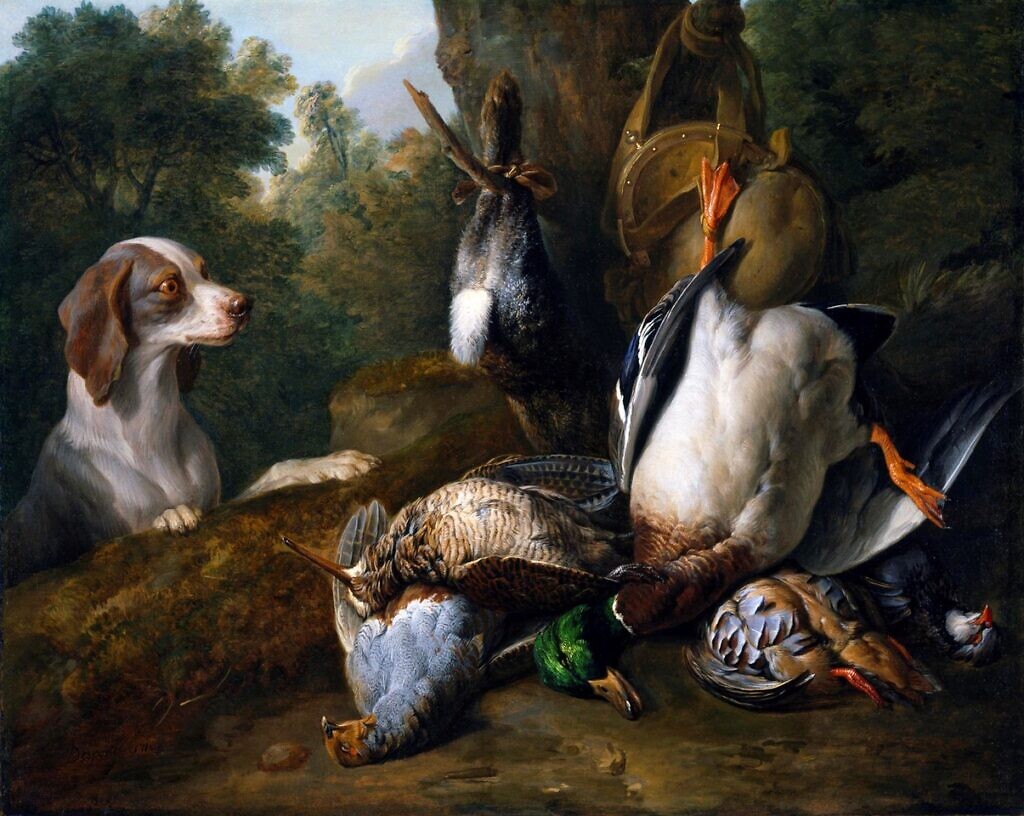
Chardin did not attempt to attract aristocratic sportsmen to his art – no hunting dogs or the taking down of stags. He did not strive to compete with France’s very first “painter to the king for venery and the royal hunting dogs,” Alexandre-François Desportes (1661-1743) who followed his king’s hunts at Versailles, Saint-Germain, Chantilly, Fontainebleau, and Marly to make on-the-spot sketches in oil. In addition to painting the exotic species kept in the King’s Ménagerie at Versailles, from ostrich to marmoset, he made large portraits of Louis XIV’s favorite dogs hunting pheasants and partridges, and scenes of coursing hounds and exhausted pointers chasing wolves and boars or standing guard over dead game.
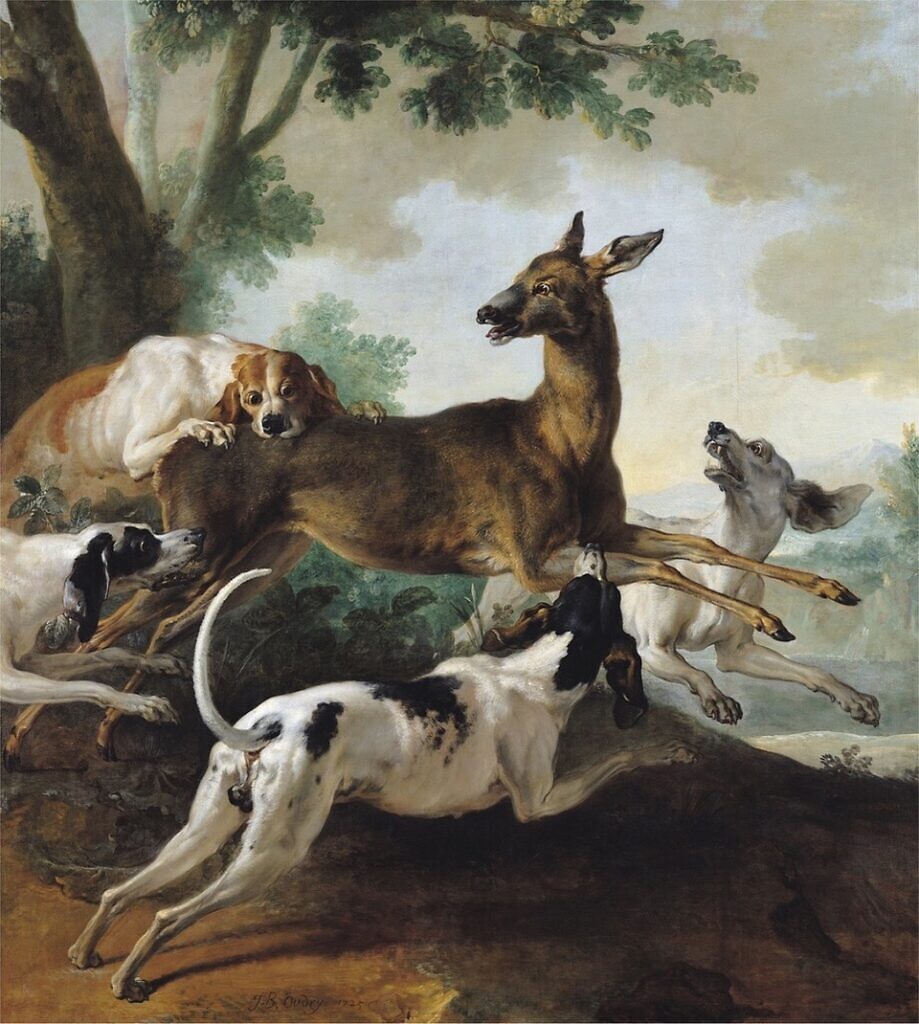
Jean-Baptiste Oudry (1686–1755), one of the most productive and successful artists of his time, was later overlooked because many of his works were inserts in the carved and gilded decorative panels typical of 18th-century royal residences. His huge and complex masterpieces of Louis XV’s hunt scenes came from direct observation of the royal hunts, which were highly organized spectacles with as many as 24 hunt captains, 780 grooms, and 400 to 900 dogs in a single outing. Able to portray the thrill of hunting dogs and prey flying through the forest in the ardor of the chase, Oudry covered the King’s offices and banquet halls with bloodthirsty packs tearing into wolf, wild boar, and red stag.

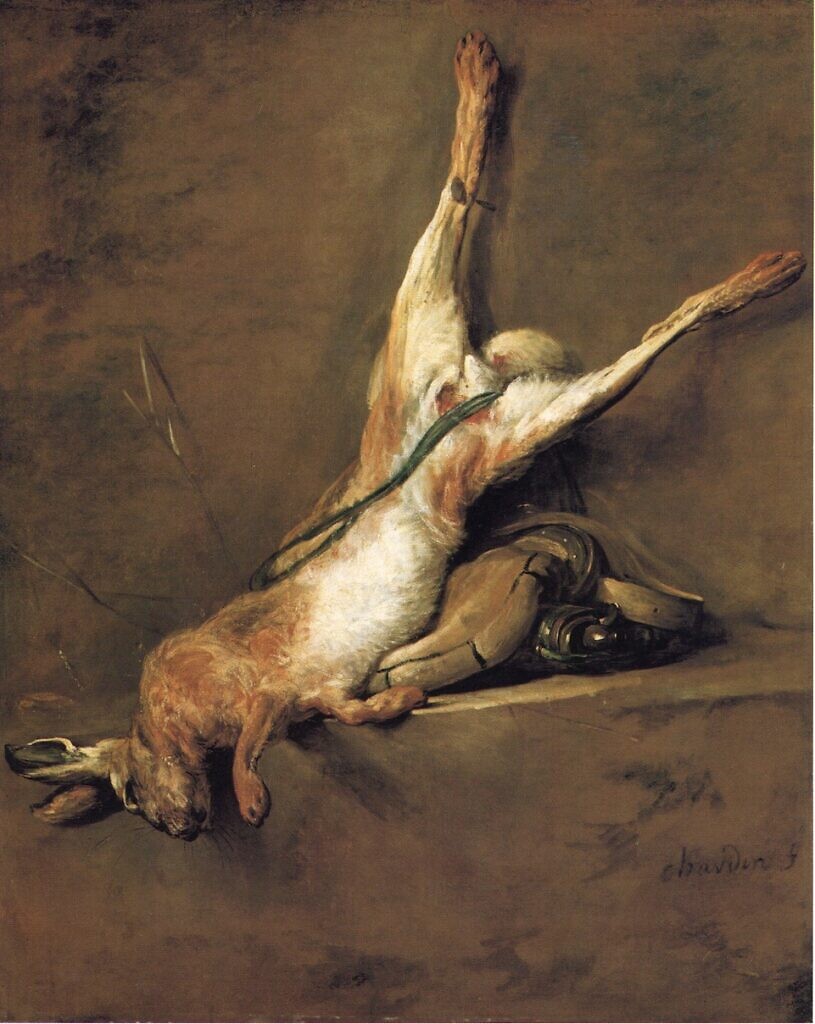
Chardin’s solemn, unruffled game pieces represent a different moment, a different mood in the hunt cycle. Works such as Hare with Powder Flask and Game Bag feel almost like alters, the boldly limp body of the sacrificial hare or grey partridge pinned to a cold, rough wall, its head spilling carelessly over the mensa’s ledge.
Many critics say that with his palette of pinks and blues François Boucher (1703–1770) is the painter most closely associated with the Rococo style, which spread throughout Europe. Boucher was a natural businessman and transformed his paintings for the decorative arts, including as porcelain figures for the manufactories of Vincennes and Sèvres, and for the tapestry manufactory of Beauvais. As first painter to King Louis XV, he knew his self-satisfied sentimental clientele well, and his evocative pastorals appealed both to Madame de Pompadour and his bourgeois buyers.

Boucher and Jean Siméon Chardin’s (1699–1779) lifespans neatly overlapped, yet Boucher’s ouh-là-là backside-baring L’Odalisque could not be more different from Chardin’s matter-of-fact still lifes and game pieces with their undefined scrumbled backgrounds. There are virtually no romps or naughty Greek gods in Chardin’s estimated two hundred works (compared to the incredibly prolific Boucher’s one thousand paintings and ten times as many drawings).
It seems hard to believe that Chardin was born just across the Seine from the rococo imagery and royal goings-on in various Right Bank palaces, in the heart of Left Bank Paris. He lived his entire life in the Saint-Germain-des-Près neighborhood and never once left the city except to work at Versailles and Fontainebleau. And he is buried in the church facing the Louvre where, in 1757, Louis XV granted him an apartment in recognition of Chardin’s improbable climb and long career within the Académie Royale de Peinture et de Sculpture. Far-fetched, because the self-taught artist of the artisan class had never studied there, even a day.
In 2023, the Louvre Museum successfully raised 1.6 million Euros from 10,000 donors to purchase Chardin’s still life Basket of Wild Strawberries, a painting considered a national treasure. On temporary display in Brest, just one hundred miles from her French family, Brooke is on her way to see it.