My decision three decades ago to hunt turkeys exclusively with traditional bows and arrows is central to this narrative. The difference in degree of difficulty between firearms and archery tackle is greater with turkeys than any other quarry I know, including grizzly bears. I’ve taken my share of turkeys with a bow during those years, less because I’m an exceptional turkey hunter than because I live near a lot of turkeys that don’t face the amount and sophistication of hunting pressure their brethren deal with in other parts of the country. Even so, I’ve worked for every one of those two dozen birds.
Bowhunting for turkeys underwent a revolution of sorts some years back with the development of the pop-up blind, which allows the hunter a mobile means of concealment. It’s hard to understand why birds that can see you blink from a hundred yards away will totally ignore an artificial blind four feet in diameter when they’re practically on top of it, but they do. The difficulty of killing a turkey with a traditional bow derives from the motion needed to come to full draw with the bird at close range. The pop-up blind largely eliminates that problem. Since the essence of turkey hunting is calling a wary gobbler into your lap no matter how you’re hunting, I justified killing a few birds from pop-ups but never felt quite right about it. On those occasions, I left the woods feeling as if I’d caught a trout on a worm during a PMD hatch. Now I’ve gone back to my old ways, relying on nothing but a bit of netting, natural cover, and good timing to let me get away with drawing my bow and delivering a lethal arrow.
After completing my hasty setup, I settled into place on a log and offered a soft tree yelp just to let the gobbler know I was there. After receiving an immediate reply, I shut up and waited for my ears to tell me when the bird had left the tree. My hope was that the tom was a lone gobbler preparing to spend the morning looking for a receptive hen.
“Spooked turkeys don’t talk like that, and I was close enough to be within the likely perimeter of his landing zone when he left the tree. And I was…”
But that was not to be. After a quick flurry of spontaneous gobbles convinced me that the bird was on the ground, I began to yelp vigorously. While over-calling is a fault to be avoided in the attempt to lure anything from turkeys to moose into range, I like to call like a fool right after fly-down to take advantage of the inevitable confusion. For several minutes, I thought I was about to enjoy a short turkey season. I didn’t hear any hens, the gobbler was immediately answering all my calls, and he sounded as if he were headed straight toward me.
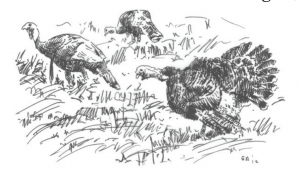
The moment of first visual contact with a calling gobbler always arouses remarkable excitement as your eyes confirm what your ears have been telling you. Suddenly, the white semicircle of a tom Merriam’s fanned tail feathers appeared over the lip of a little rise just up the hill from me, and I foolishly allowed myself a silent Gotcha! That’s when everything fell apart. First I heard a hen yelp. Then dark figures were swarming over the hill beside the gobbler like ants. Finally, the slutiest-sounding hen I’ve ever heard began to yelp like an actress in an X-rated movie for turkeys.
I just couldn’t compete with the real thing. The gobbler followed the hen past me, 40 yards away. Since any turkey is a difficult target for a bow at half that range, discipline overcame the temptation to launch a Hail Mary. The birds disappeared in the direction of my house. I remained crouched amidst the branches of the fallen tree, calling intermittently and hoping the tom had ended the tryst one way or the other.
I gave it two hours, then picked up and walked home for breakfast.
THAT EVENING FOUND LORI AND ME BACK ON THE DECK with a slab of last year’s king salmon, and the wirehairs reminding us that the Labs had received treats the night before. “Where are you going tomorrow?” she asked.
“Guess I shouldn’t ignore those four hundred turkeys out on the divide,” I said. Then we both heard it, too loud for anyone to ignore—a thunderous gobble just over the rim of the coulee that couldn’t have been more than a hundred yards away. The dogs barked, and the turkey gobbled back at them.
“Get your bow and go shoot him!”
“It’s not like that,” I said. “You hunt spring turkeys in the morning, not at night.”
“Why?” Lori asked.
“I don’t know. For the same reason you don’t shoot turkeys out of trees or cast blindly to bonefish when you can’t see them anymore.” Although an accomplished bowhunter in her own right, Lori has never been able to wrap her brain around turkeys. Probably because her brain is larger than mine.
“So what are you going to do in the morning?”
“You don’t leave birds—”
“I know,” she said. “Eat the last of that salmon.”
I remained on the deck until color had drained from the landscape, confident that my ears had accurately pinpointed the gobbler’s roost tree 200 yards behind the kennel.
The following morning, the dogs sounded off when I tried to sneak past them in the dark, but I reasoned that the birds were used to them. Certain that I was dealing with the same tom and likely the same company of hens, I tested the limits of more than enough by creeping within 50 yards of the spot where I thought they had roosted. By the time robins started to chirp, I felt securely hidden and happy with the position of my decoys.
I felt even more confident when the bird began to sound off practically overhead. Spooked turkeys don’t talk like that, and I was close enough to be within the likely perimeter of his landing zone when he left the tree. And I was— in fact, several hens practically landed on top of me, although none appeared aware of my presence. But the gobbler wasn’t interested in those hens. He only had eyes for another shameless hussy as he strutted past me at 30 yards—close, but not close enough. By the time I stopped calling and headed up the hill to feed the dogs, I was thinking about the last turkey I’d killed with a shotgun. Nothing about it seemed regrettable.
That evening, my bird sounded off as we were eating the last two mallards from our freezer. “Here we go again.” Lori said, “Sure you don’t want to go look for those four hundred turkeys out on the divide?”
“I’m sure,” I said. “This has become personal.”
“How can anything become personal with a bird?”
“You’d have to be there to understand. Matter of fact, why don’t you come with me in the morning?”
“Because I’m smarter than you are.”
The following morning I set up on the gobbler again. This time I called sparingly, offering just a single yelp when he left the tree. And once again, I watched him follow his hens off into the distance without offering me a shot. This time I stuck it out until noon, but I never saw the bird again.
 Shortly after that last futile encounter, we left for our old Alaska hometown to chase steelhead for two weeks. A few days of spring turkey season awaited me upon return, but I never made contact of any kind with the gobbler in our west coulee. He may have left the area, or he may have bred all those hens and shut up for the year. In either case, our chess match was over. Perhaps I’ll run into him when I’m hunting deer this fall. Montana has an autumn turkey season, but I doubt I’ll take a shot if I do catch up with him. We had established the rules of engagement during the month of April, and to kill him during a chance encounter in November would be disappointing, no matter how good the bird tasted smothered in morels we’d gathered in Alaska.
What of the 400 turkeys on the divide? They turned into the season’s ultimate McGuffin. I never even went out to look for them. Was that wise? Obviously not, at least if you measure the success of a hunting experience by the quantity of game in the bag. It is impossible to kill fewer turkeys than I did hunting behind my own barn this past spring season, and I will not pretend that I don’t enjoy killing big, mature gobblers with my bow.
However, I have reached an age at which I’m willing to sacrifice results for intensity, and I find something indescribably intense about devoting my energy to the pursuit of one specific quarry, be it a bull, a buck, or a bird. That tom threw down a gauntlet when he gobbled at me from my own backyard, and for better or worse, I picked it up. I might have lost the duel, but I wouldn’t have missed the fight for anything—not even for a morning surrounded by 400 turkeys.
If they really were out on the divide last spring, some of them will be back this year. Perhaps I will be, too.
T. S. Eliot called April the cruelest month. During the years he spent in Alaska, Don Thomas longed for Montana spring turkeys. Now that he’s back in Montana, he feels the same way about Alaska spring steelhead. Perhaps Eliot was right.