WOULD PAUL TELL HER HOW IT HAD BEEN 35 YEARS SINCE HE SHOT HIS FIRST GOOSE? Thirty-five years, and he could still see it stall in midflight when he shot straight overhead with his brother’s 16 gauge. Would he tell her that every goose since had brought the same excitement? The sound of them alone brought the same rush, whether sky-high on their migration with the faint, distant, age-old music spoken as if from the clouds or the quiet murmur as they appeared from the fog to circle once and then drop their feet straight for the spread. He theorized that a goose for the holiday sanctified country living, rich or poor. How he could feel their thick winter down like cotton on their breasts—smell the fresh, northern air from their travels when he plucked them out— loved to see the yellow, marbled skin that he knew would be perfect for the grill. Oh, she’d eaten her share. She loved the geese and ducks. Both his daughters did. Birds were the first meal he cooked his wife, not knowing she was vegetarian at the time. This group took a peek, circled once, and headed up-river.
Was it the spoof they detected? Paul felt confident they couldn’t possibly have seen him and the dogs. Too many eyes for the last days in January. That’s all. Too many eyes. Quiet returned as Paul stared at sagging corn stocks surrounded in white.
“…these were big, winter-tough, and wary honkers, already paired for spring. Sixty yards, 50, 40, 30…”
He wondered, just when had those little duck tracks and the heavier prints of geese occurred? He was sure it had been within the last day, yet they were not fresh enough to be that morning’s. Afternoon feeders, Paul decided—they had to be. The younger and quieter of the Labs circled the snow, scratched at it, then bedded down with a groan. The older female stayed intense, ever faithful to the thought there could be action any moment. But the pall continued, and the strange hollow afternoon kept working on him.
ANOTHER FLIGHT OF TOO MANY GEESE CAME OFF THE RIVER, and a few ducks trailed it. The geese looked only once before setting for another field. The mallards, however, broke back and swung the field twice and dipped toward the spread about 60 yards out. Paul readied himself, deciding the small group’s next swing would be lower and he would shoot. He’d push the distance with bigger loads. Overland, a cripple wouldn’t be a problem with two dogs on it. The ducks set up for their next swing over the trees. He saw the lead drake, stood, and began his swing. … Not a shot, he thought. He would not even have considered it if Camille had been there. He knew it wasn’t a good shot. A cripple is a cripple, he repeated to himself. A potential intentional cripple was even worse. “Not a shot,” he heard himself say. He hoped his daughter’s interest would hold up and spare him hunts alone with his thoughts.
The ducks flared when he rose, but he was surprised that the late-season birds approached the field at all and risked feeding during the day—it just wasn’t cold enough for such a gamble. Just about all good field hunts Paul recalled over the years had one common ingredient: cold. Today, it was above freezing, not close to the right sort of cold. The last half hour, or more precisely, that last 10 minutes of legal shooting hours often made all the difference. Having lasted this long with his tainted thoughts on the last day, Paul planned to hunt to the bitter end. He owed it to the dogs. Plus, when he got home, she’d be there to ask: How was it?
A northerly breeze stirred from the river behind him. His ass was sore from sitting, but he knew it wasn’t the time to get up and go for a warm-up walk with the river just starting to darken on a dark day, and a check at his watch showed 20 minutes until closing for the day, the week, the season. Paul felt the age-old lift in anticipation with the subtle change in light.
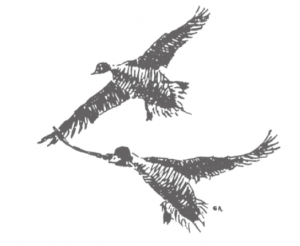 Something caught his eye—something above the far edge of the corn against the farther, almost impossible backdrop of dark bluffs also blotched in snow. Then there was another flicker and he picked out the white movement of wings and breast; then he saw the pair low, already hooked in the right direction that would take them up the edge of the corn. The birds would either set to the dekes or rise up for the river. He felt himself sink in his seat as he held his breath.
The pair of geese kept coming, closing the distance without making a sound. “Both or neither,” he’d already told himself. If she had been there, he’d explain later why he wouldn’t risk just one. He was loaded stiff with number 1s, and these were big, winter-tough, and wary honkers, already paired for spring. Sixty yards, 50, 40, 30. They flared up over the silhouettes. Now, that’s a shot! Paul almost shouted as he stood and swung with them. He crumpled the first bird, then panicked after missing the second shot, but staying with it, tripped the second with his last shot. He could still see the second bird falling after the two distinct thuds, and the dogs raced out across the crusted snow to bring in the pair. It hadn’t taken that long…
She met him at the door, and he could still see the busted feathers waving in the gray winter air as he ran his cleaned hands though her hair. “Got those ones, huh!”
“And maybe we’ll get more next year,” he said.
“Yup. Maybe with my own shotty.”
Maybe so? Maybe next year, a buckled bird or two of her own for the Labs. Paul couldn’t wait.
Sam and his wife own and operate an organic-grain business in Washington State. In his “spare time,” he enjoys two daughters, hunting, skiing, and writing. His work has appeared in Gray’s for more than 20 years.