AFTER THE FIRST HILL I’M WINDED, and sit down to rest, looking out over the woods. I’m up high now, higher than the ranch, and the woods up here aren’t nearly so green as those I’ve been seeing. The air’s cold and there’s only a hint of spring, the faintest sprinkling of green. The tall spruces on the mountainside tower above me. Just a mile off the road, and it’s as if I’ve entered a new world. I hear or see nothing human except the path, an old game trail appropriated by fishermen for getting to the creek.
When I was a child and my father took me elk hunting in these mountains, I saw the deep woods for the fi rst time. I remember stumbling upon the remains of what my father said was probably a mule deer. The only intact part of the skeleton was the skull. The rest had been scattered.
“Coyotes,” my dad said. “Vultures. Ravens, too, probably. Picked it clean.”
I took the skull home and hung it on my wall. Every time I saw it, I thought about the woods. About how out there things just dissolve back into the earth without a funeral. About how one creature lives upon the flesh of another. I realized that the world didn’t need people to keep it going. In some ways, I’ve never gotten over that single thought. It still comes back to me whenever I enter the woods. But I did think that human beings could understand the world. I guess that became my defense against the mystery of that skull, against the mystery of the woods themselves.
I loop the tippet through the eye of a Pheasant Tail, and then grasping a ninepenny nail with my mangled right hand, I try to tie the knot.
Something of that impulse was what sent me into medicine and surgery. And now that I can’t do surgery anymore, I’m at one of those in-between places. A path comes to an end, and you either stop traveling or find a new one. But I’m discovering that when you hit the end of a path and don’t know where else to go, you look more closely at the world.
Today, as I remember the bones of that deer, I’m not thinking about dying. I’m thinking about living. About how little I really know about the woods or even that creek I can already hear cutting its way down through the mountains.
I sit and look at the woods and then drink water from my bottle. I have to climb about another half mile, and then I’ll start descending to the creek.
Though the path is clear and well tended, it’s a hard climb, some of it nearly straight up. But I won’t climb it sitting here thinking. And there’s no other way to the creek. By the time I get to the top of the ridge, I’m gulping for air. The sun is edging over the low ridges to the east, casting light into the valley where the creek winds through. Early morning mist hangs in the valley below me. My heart thumps in my chest.
The path down to the creek is a series of switchbacks, the declivity around it plunging down toward the water. And there at the bottom is the stream— the center of the picture. That’s why I came, and it’s why the fish are here—even the mayflies and the stoneflies and the caddis flies and the midges. One way or another, all of us live off that stream. Just like everything else.
THE WATER LOOKS A TAD HIGH, but not too much, I hope. The early spring started some snowmelt low down, and there’s been some rain. But we’re weeks from the heavy melt that will suspend fishing until it runs down.
I head for the widest part of the creek, a place where it twists and then straightens amid the fl at bottomland before it meanders down again, cutting away and dissolving the rocks and the earth as it has done for eons. I know that the trout will be holed up near the cutbank in the curve of the channel, hanging just at the edge of the fast water. It’s the only way they can live, just hanging there, maintaining their place at the edge of the drift, wary of the shadows above them, living on whatever the current brings.
But when I get to the edge of the creek, I can’t see any trout rising, no matter what angle I take. The water is just a bit cloudy and fast—the snowmelt, the rain. I look at the water for a long time, wanting somehow to know what I’m up against, what the trout might be hitting.
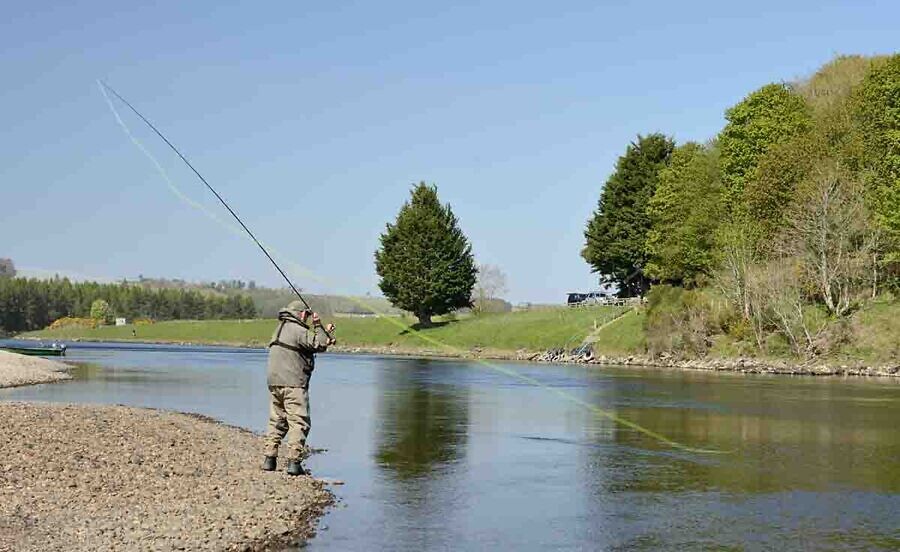
Then I head away from the creek, uncase and assemble my rod, take off my pack, and start gearing up—waders, vest, boots—my mind no longer on the deer skeleton but on the clinch knot I’ve got to tie. I loop the tippet through the eye of a Pheasant Tail, and then grasping a ninepenny nail with my mangled right hand, I try to tie the knot. I’m right handed, and find it awkward to manipulate the leader with my left hand. It takes more than a few tries.
 All the while, for some reason, I’m thinking about the caddis, the strange journey it makes from the bottom of the stream as larva, to the pupa that heads upward in starts and stops, oaring along, drifting with the current until he emerges onto the surface, leaving the old body behind to fly away as a new creature. If he’s lucky, and a trout doesn’t eat him somewhere in his journey.
Every lurch, every jerk, every movement, every moment of the journey and the transformation from larva to winged insect is fraught with uncertainty and danger. Every single caddis fly that leaves the stream and takes to the air is a tiny miracle. And yet the cycle repeats itself a million times in a million streams every year.
As I enter the water, and feel it swell and swirl and flow around my waders, I feel its cold through the thick fabric. I’m in the current, and I feel it push and pull against me.
For whatever it’s worth, it’s another spring, and I’m fishing. I, too, have emerged, at least in a certain strange sense of the word, and with every step I continue my uncertain journey on this earth.
As I balance the rod awkwardly in my mangled right hand, pulling my arm back to cast, I must see what I can do with it, see if I can catch a fish.
H. William Rice chairs the English Department at Kennesaw State University and lives in Rome, Georgia. His most recent book, The Lost Woods, was recently published by the University of South Carolina Press.