Split Bamboo
by David C. Meyer
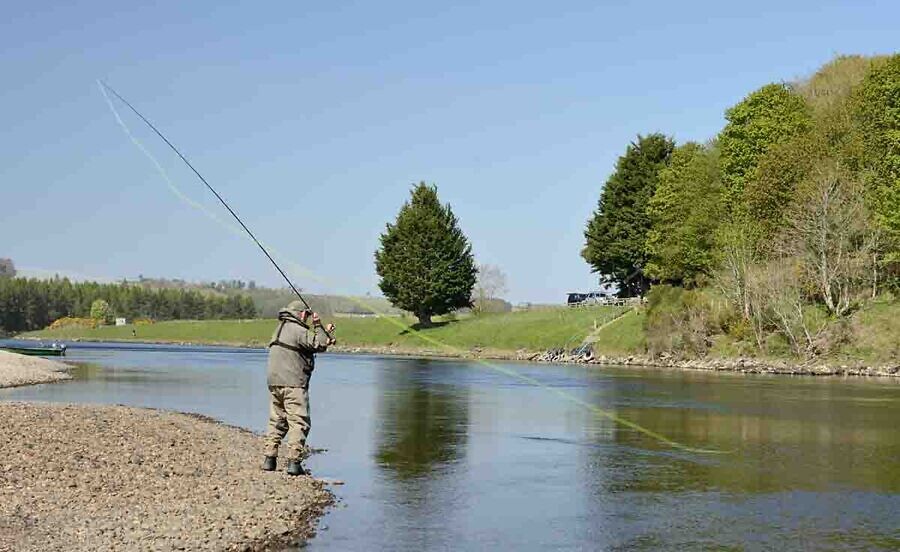
Over and over I cast across,
line, leader and scud fluttering
featherlike onto a riffle. The scud
settles through a dark, undercut bend.
Intent on its drift, I too settle,
in muck, so that, trying to shift,
my boots sucking, balance fails
and I lunge forward into the springfed
water. Desperate to protect
the wisp of rod built by my own
hands, arms fly up, and I plunge
face down, waders gulping, cold
seizing my heart, my breath, surrendered
to a fragile elegance.

Relaxing Jar
For Robin
by Gary W. Hawk
It is raining now after a morning
along the river, the fish put down
by the splat of thunderstorm drops.
We walk back, trying not to slip
on slick cottonwood limbs, slopes
covered in needles and wet leaves,
parts of the trail carved away
by high water and bank beavers.
We talk as we walk. He remembers
his collection of butterflies and beetles
mounted and displayed for a contest
in Milwaukee’s museum.
Now, in his seventies, he sends off
for a few favorite specimens, still fresh
in his mind, and mounts them once again
in frames too good to discard.
He places a butterfly in a “relaxing jar,”
a glass container full of moist cloth.
Inside, the brittle remains of a blue morpho
begin to absorb humidity as the living do
in the jungles of Costa Rica and Belize.
When the hinges between bright blue panes
soften in the humidor, they relax
instead of crack, and so are prepared
for their great but final opening.
Even his voice softens as he remembers
and describes his new display, this man
whose hands, thickened at the oars,
slow over the mouth of the jar
then reach into its chamber to resurrect
the blue sails, unfolding them
with now the gentlest touch.
Old Buck
by Matthew J. Spireng
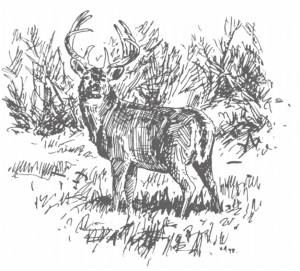
Begun before dawn, the snow still falls
thick and wet. Even under the hemlock
where I’ve been lying all day, it is
cold and damp, and wind sweeps in
so my fur feels thin and patchy.
Scents snatched from afar
drift to where I lie, heavy head up
and alert, then dipping. A weariness
fills me in this weather, as if
I’ve been running does all day.
This huge crown weighs on me,
and even as dusk pulls me up,
I long to lie and let sleep come,
my head sink, cold and snow
clinging as night draws me in.
Aching, I rise in search of food,
test the air for dangers, a silence
of drips all around, so alone
until a light comes loud and blinding
from the dark and I am young and running.
Red Union Suit
by Sydney Lea
From my favorite old store, before the outfit turned
to wrap-around skirts, so-called activity wristbands,
and all the rest. Red union suit. Two-layered,
dug out when I sorted through the ancient trash bins
I use to store gear. Relic from an exotic era:
You were the first thing I picked up as I assembled
clothes for the river, where I’d call what ducks I could
dawn upon dawn. So many good Novembers.
Mostly redleg black ducks blown in on some norther.
They still set their wings in mind as marsh-weed hisses.
I come home, with ducks or not. Off with the camo,
wooden calls laid on the table as I fuss with dishes.
Red union suit. I wear you as I wolf my eggs,
sprawled in a chair like a derelict, already
a man for recall, dreaming the month just past.
October grouse. Autumn-wild foliage. Points steady,
the collar bells gone silent in puckerbrush.
Me, dropping easily into a pushup posture
to suck the sweet, cold water from some backwoods brook.
My two dogs in this trance are Hector and Monster.
Red union suit, I never wore you to the party.
There was always a party back then. I had no kids
in my life at all in those days, not to mention their kids.
I did whatever I wished for as long as I wished.
Oh say, red union suit, was that really me?
These days the man who wore you seems a stranger,
More amply girthed, his five children grown and gone.
To be sure, he’s happy as any limit-day hunter—
no, even happier. His old-time pals, who sat
with him those hallowed mornings in blind or canoe,
or joined him upland, remain as dear as life.
I mean the blessed ones who yet survive—
yes, they’re dear as ever to him, and are strangers too.