Or, More of the Same
by Brooke Chilvers
Until you read it, study it, or figure it out yourself: You are not losing your mind when, standing before a painting by Lucas Cranach the Elder (1472–1553) of a demure Adam and Eve, or an agonizing Lucretia pressing a dagger to her breast, or a sober portrait of the artist’s friend Martin Luther, you are totally convinced you’ve seen this work before.
Why? Because Cranach’s effective overseeing of an efficient studio allowed him to create slightly varied or lightly recomposed variants, sometimes dozens of times, of his most in-demand subjects. In his hunts, for example, the horses gallop sometimes to the left and sometimes to the right. And his trio of Roman goddesses are pretty much a restyled and retitled The Three Graces; or vice versa.
Before I learned this, I was utterly confused by Cranach’s similarly titled, similarly composed panoramic oil paintings, in Vienna, Madrid, and Cleveland, of the Prince-Electors of Saxony’s elegantly staged driven-stag hunts at their hunting lodges near Wittenberg. For in this culturally isolated region, Cranach’s most important patrons during his lifetime were the Prince-Electors of Saxony, Friedrich III the Wise (1463–1525), Johann I the Steadfast (1468–1532), and Johann Friedrich the Magnanimous (1503–1554).
As court painter, in 1506-07, Cranach accompanied Friedrich the Wise and his court – including administrators, a church choir, and huntsmen – on a six-month hunting trip to his medieval fortress, Veste Coburg castle, in the Upper Franconia region of Bavaria. There, one of his tasks was to decorate the banquet hall, the Große Hofstube or Great Court Chamber, with hunting-motif murals. In addition to his salary, the thrifty painter, engraver, and printer had negotiated his amenities to include lodging at the castles, good meals and drink, his fine wardrobe, and the caring of his horses – an arrangement that lasted much of his life. Although the Veste Coburg still contains some 30 of Cranach’s works, and can still be visited today, his hunting murals, alas, have not survived.
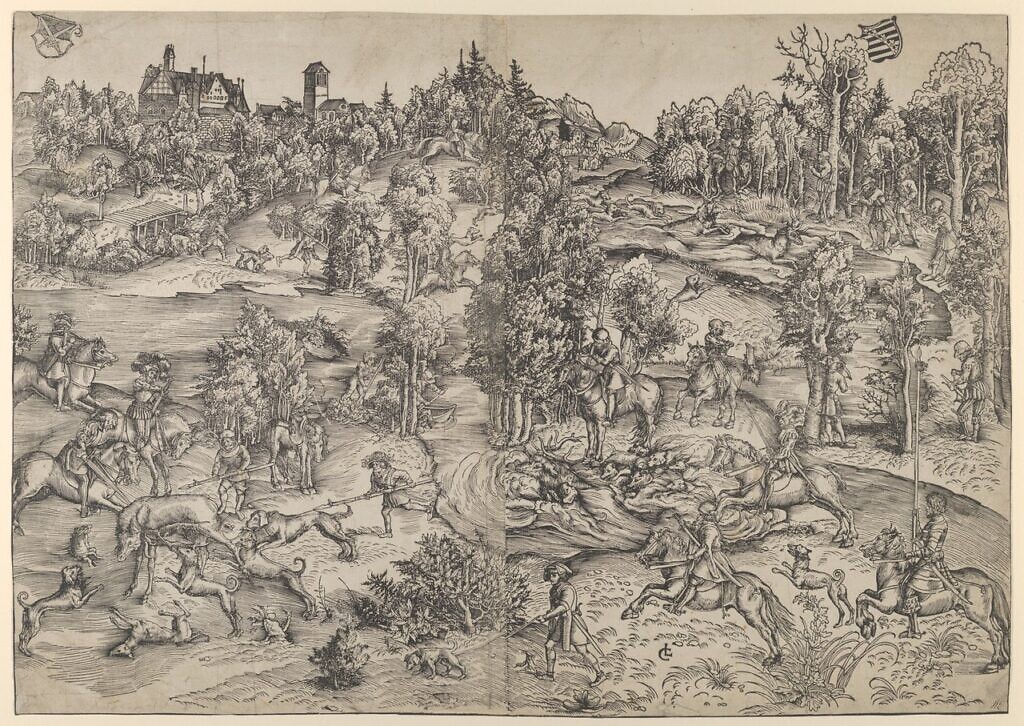
An early woodcut of a stag hunt from this period, at the MET, already demonstrates what will become Cranach’s signature bird’s eye-view over his circular composition of the hunt’s timeline. It is meant to be “read” clockwise from the top as the chase unfolds. The artist carries the viewer’s eye from the hunting dogs being led out from the kennel by the valets de chiens in the upper left, to the huntsmen on horseback hotly forcing the deer into the rushing river. Finally, in the left lower corner, the stag is harassed by the dogs and felled by pikes. I do not know if an original oil of this woodcut exists.
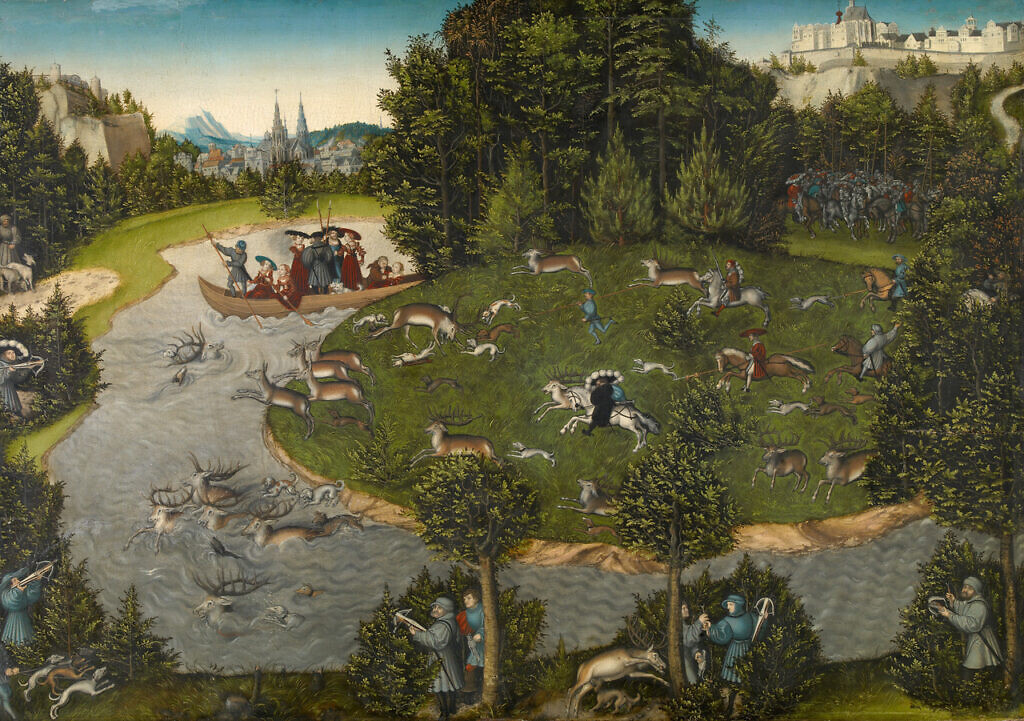
One of Cranach’s earliest hunt paintings, Vienna’s Deer Hunt of Elector Friedrich the Wise (1529), likely recalls an actual hunt put on in 1497 by Emperor Maximilian I at his Innsbruck court with both the Wise and the Steadfast present. The three royal hunters are pictured posted in the thickets on the far side of the curving river, their crossbows at the ready, as they face the fleeing deer, plunging into the waters pursued by hounds and horsemen to the island’s edge. The well-dressed court ladies chatting and flirting in a nearby party boat transform the scene of blood sport into a social outing. The painting was probably intended as a diplomatic gift that refers to past alliances – or ones that should have been – as both Frederick and Maximilian were already dead when it was commissioned, probably by the Steadfast.
Cranach was also consulted on the rebuilding and decoration of Friedrich III’s Castle Annaburg on the game-rich Lochau Heath, as well as Castle Hartenfels above the pretty Renaissance town of Torgau with its views of the Elbe River. Friedrich, who was born in Torgau and died in Annaburg, is mostly remembered today for having sheltered the banned and excommunicated Martin Luther in his castles while he translated the New Testament into German, which Cranach illustrated; in fact, Luther’s first church was in Hartenfels castle. Both castles can still be visited, but Cranach’s work at Hartenfels was destroyed by Spanish forces when Catholic Holy Roman Emperor Charles V attacked the Lutheran Schmalkaldic League in 1546. But that’s another story.
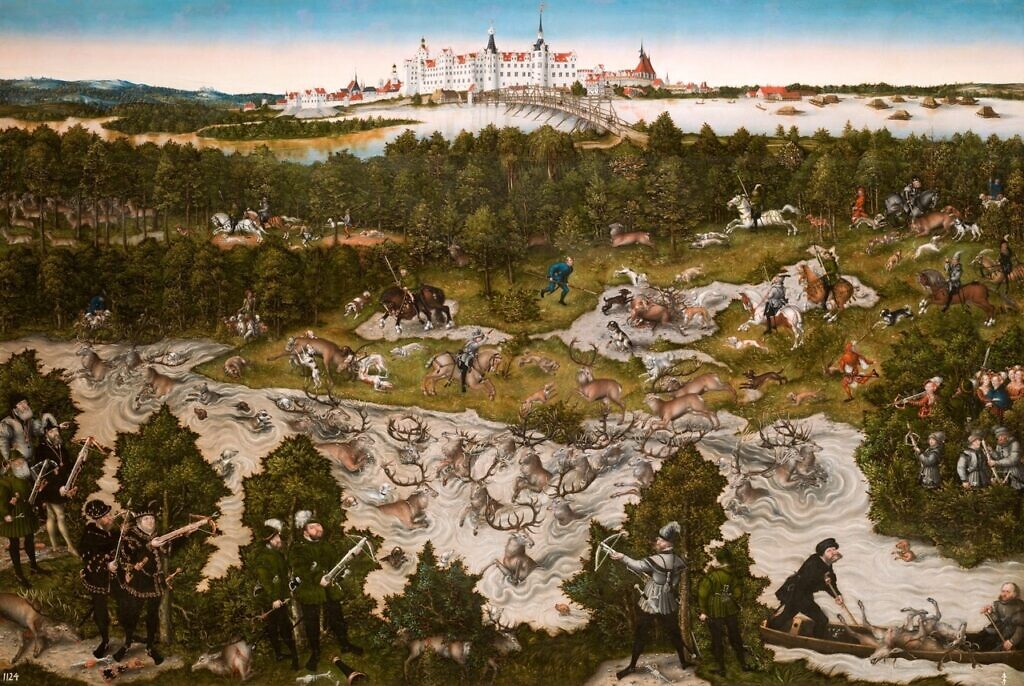
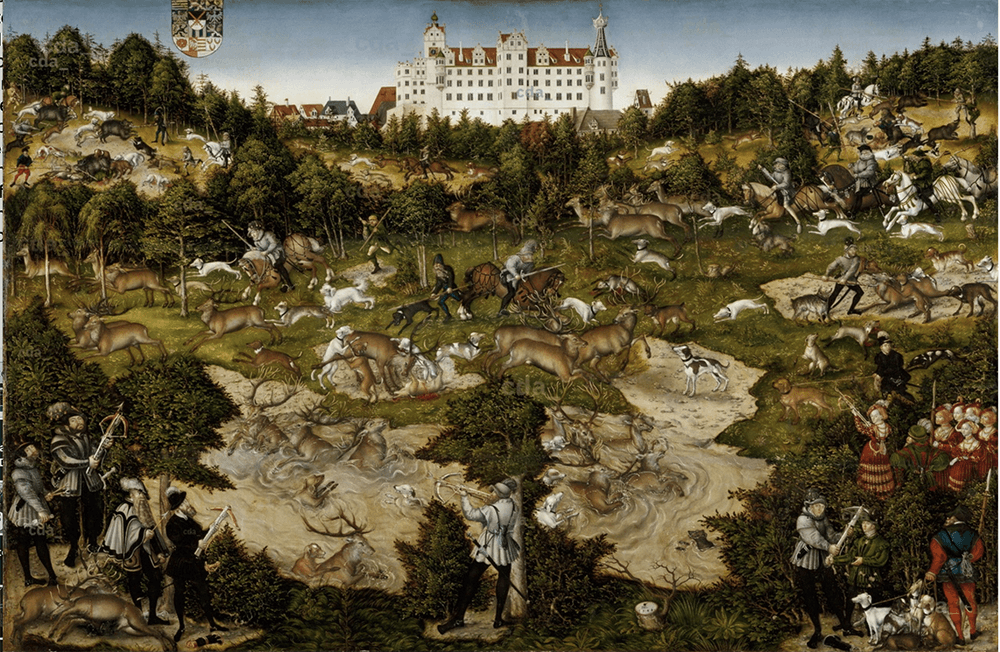
Hartenfels Castle appears smack in the middle of several of Cranach’s most well-known hunt paintings: The Stag Hunt in Honour of the Emperor Charles V at the Castle of Torgau and Hunt at the Castle of Torgau in Honor of Ferdinand I, both in Madrid’s Prado; and Hunting near Hartenfels Castle in Cleveland.
Interestingly, several of Cranach’s paintings commemorate hunts that never actually took place! Instead, they are symbolic expressions of the cooperation between rulers for the sake of good governance, as well as a tactful reminder of the land-tied legitimacy of the Saxon line. The Prado’s The Stag Hunt in Honour of the Emperor Charles V at the Castle of Torgau (1544) recalls an encounter that never existed, yet Emperor Charles V and Johann Friedrich are flatteringly pictured in the foreground hunting deer together. It was likely a gift, as it was brought to Spain by Maria of Hungary and has been listed in the Prado Palace inventory since 1564.
Cranach’s formula was to basically switch out majesties within the same schema – Emperor Charles V for Maximilian I, for example – which allowed the electors to pay personalized homage to their prestigious guests.

The Prado’s other, similar, painting, Hunt at the Castle of Torgau in Honor of Ferdinand I (1545), shows the Magnanimous with Ferdinand I, Emperor of Austria and King of Bohemia, Hungary and Croatia, who became Holy Roman Emperor in 1556. Hidden to the right is Johann Friedrich’s huntress wife, the Electress Sibylle of Cleves, whose portrait Cranach famously painted several times. In Cleveland’s Hunting near Hartenfels Castle (1540), we recognize the Magnanimous in the lower left corner wearing dark green, spanning his crossbow. His wife, Electress Sibylle, is an even stronger presence in this painting, avidly awaiting her honorary first chance at a stag.
In the end, it really doesn’t matter how many Cranach goddesses, saints, and hunts one sees in a lifetime. For me, each one is like crossing paths with an old friend.
For a giant dose of “everything Cranach,” go online to the Cranach Digital Archive. They have studied 1,139 oil paintings in 152 museums, collections and churches, and are now turning their attention to his prints and drawings.