by Brooke Chilvers
Having missed out on childhood Bible stories in favor of the Sunday children’s choir in the chapel at St. Bart’s with my best friend Anne, most of what I learned about saints and martyrs, whether Saint Catherine’s beheading or Saint Barbara’s execution by her pagan father, was through paintings at the MET Museum by Lucas Cranach the Elder (1472–1553).
Cranach created my lasting images of a blonde Christ blessing the children, and his shielding the adulteress from an angry crowd calling for her stoning. I remember a satisfied Judith holding up her bloody trophy, and Samson cuddled in Delilah’s lap in the moment before she betrays him.
Ditto for Greek mythology. Cranach showed me a naked sun god Apollo and his twin sister Diana embraced by the abundance and safety of their primeval forest, the huntress resting on a well-racked stag.
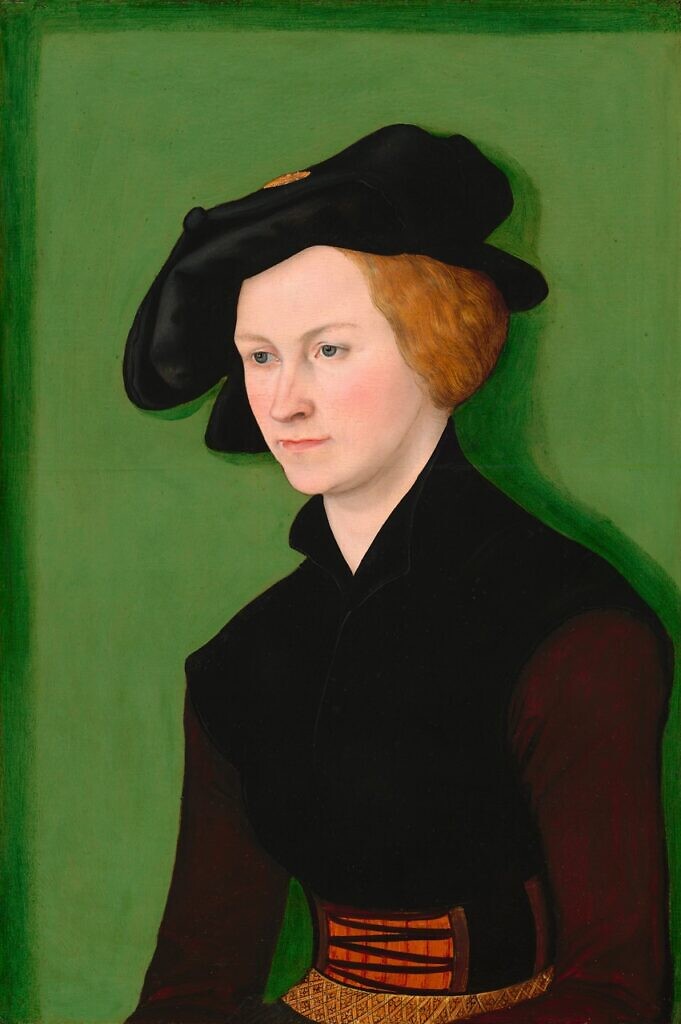
I was to be forever drawn to his richly colored landscapes seen through the windows that decorate and give depth to his German Renaissance-style portraits. But I also love the velvety greens and almost-aquas, and the frank simplicity of his pared-down compositions, such as Portrait of a Woman or of his friend, the Reformation leader Martin Luther, whose wife and deceased parents Cranach also painted.
In London, I began noticing a confusing number of Cranach’s raped and shamed-to-suicide Lucretias about to stab their hearts; there are different versions in the Courtauld and Royal Collection Trust alone. In fact, Cranach painted the nearly naked goodwife at least 40 times. There are least six different versions in six different museums, including the Museum of Fine Arts, Houston; the Brooklyn Museum sold theirs at auction for over $5,000,000 in 2020.
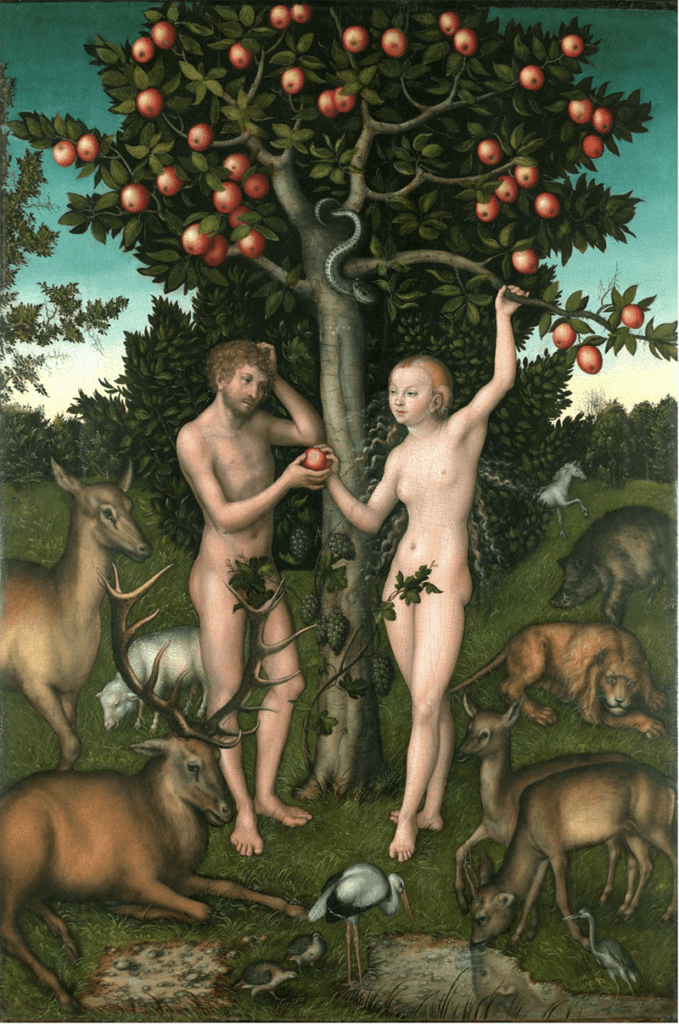
Ditto with Adam and Eve. I’ve seen Cranach’s lovely nearly life-sized versions in London, Vienna, Dresden and Chicago, out of an estimated 50 paintings with the same title.

It’s impossible to follow the centuries splitting and jumping of the hereditary lines of power in the Electorate of Saxony, an important state (think of Meissen, Dresden, Leipzig, and Wittenberg, where Luther famously posted his 95 Theses in 1517) in the Holy Roman Empire. There were brothers who ruled together and fratricidal wars and partitions, not to mention foreign invasions. Cranach, as court painter – first to Elector Frederick II the Wise (1486–1525) who protected the banned Luther in his Wartburg Castle after the Edict of Worms; then to Johann I the Steadfast (1468–1532), and finally Johann Frederick the Magnanimous (1503–1554) – lived in the middle of one of history’s most divisive religious upheavals. Cranach acted as best man at Luther’s wedding, and they were godfathers to each other’s children, but he never refused work from Catholic patrons, including Cardinal Albrecht of Brandenburg.
Whether intended or not, Cranach was the primary visual propagandist for the Reformation, creating its “face” with his woodcut portraits and illustrations for its first broadsheet. He also did all 21 full-page woodcuts of the Apocalypse for Luther’s translation into German of the New Testament (which did not prevent Pope Leo X from excommunicating the unrepentant Protestant). With the help of other hands, his portraits of Luther were repainted and the engravings reprinted numerous times. In fact, the artist’s older son Hans, who died in 1537 at age 24, is said to have painted many thousands of copies of Luther’s portrait.
His other son, Lucas Cranach the Younger (1515–1586), would make 34 woodcut portraits of the entire impossible line of Electorate of Saxony rulers from the ninth century to 1563. There are so many of these engravings that most museums do not bother to illustrate them in their online collection searches. You can see 26 of them on the Royal Collection Trust website: www.rct.uk/collection/609015/woodcuts-of-the-dukes-and-electors-of-saxony
In 1532, Johann Frederick ordered 60 pairs of portraits in oil on panel of his dead ancestors, Frederick III and Johann I, to be tactfully distributed for diplomatic purposes; versions are found in the Royal Collection, the MET, the Regensburg Museum of History, and private collections.
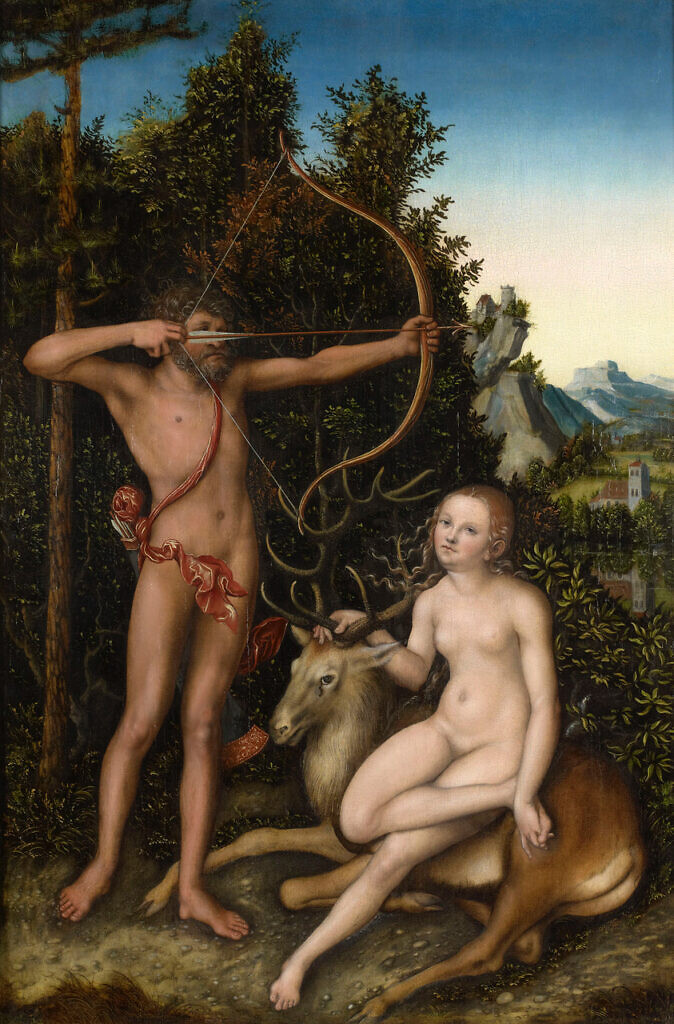
Once Cranach had a branded, recognizable style, he established a productive studio, creating variations of his characteristic slender, slouching nubile females clothed in transparent gauze. Apollo and Diana are an easy fit for Adam and Eve; and the three goddesses, Minerva, Venus and Juno might as well be the Three Graces. For his action-filled scenes of royal driven-stag hunts, he simply substituted monarchs, switching out Maximilian I for Emperor Charles V for Ferdinand I. In fact, these hunts were mostly symbolic, having never actually taken place, or were painted posthumously in honor of alliances that might have been.
For Cranach was as much a businessman as artist, maintaining, for example, the copyright or patent for engravings of his paintings. Granted the right to bear a coat of arms (a black bat-winged serpent holding a ruby in its mouth) in 1508, Cranach was allowed to acquire a print shop where he could reproduce and publish his own work. He also owned a pharmacy where he benefitted from wholesale prices on his oil-based paints and solvents, as well as medicine, wax, ink and sugar. He already had a license to sell beer and fortified wines. By 1528, Cranach was the richest landowner and highest taxpayer in Wittenberg.

Above all, Cranach benefited from the fact that – unlike Vienna where he worked and lived as a young man – Saxony was a relative cultural wasteland with no competitors for his market of fortresses, palaces, and hunting lodges.
Despite the massive loss of artworks during innumerable European wars since the 16th century, between 1,000 and 1,500 oils by Cranach — and his studio— have survived. That’s enough to go around to countless châteaux, castles, and museums everywhere.
Brooke Chilvers has given up trying to track the Saxony Electors. “For our purposes, let’s just say that after the Saxe-Wittenberg line of The House of Ascania died out in 1422, the duchy and electorate went to the House of Wettin, which itself became divided in 1547 into the Ernestine and Albertine lines. Which then….”