A grouse trial exhibits the best pointing dogs of the Northeast
by Teresa Mull
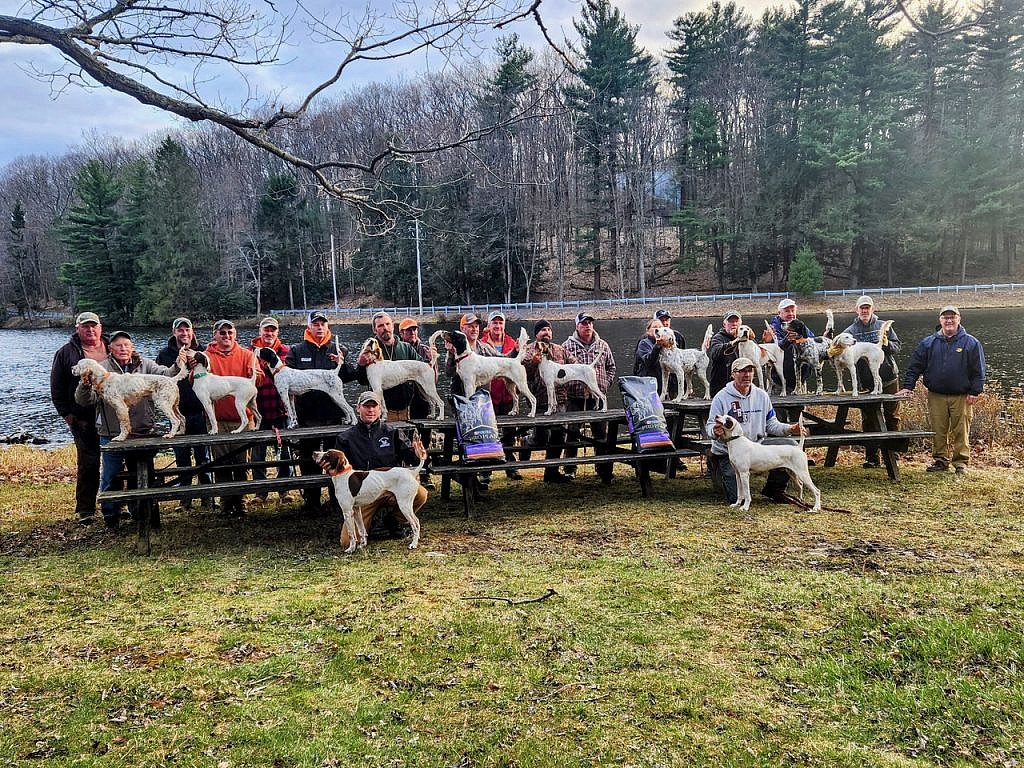
Last April, I was invited by my friend Jeff (yes, I know him through the gun club) to the town pub for the opening “ceremony” (platters of deep-fried appetizers and pitchers of beer) of the prestigious Grand National Grouse & Woodcock Invitational dog trial, held for the first time at Black Moshannon State Forest in central Pennsylvania. “This will be the 14 best grouse trial dogs from Maine to Minnesota,” I was told.
The parking lot is a license-plate buff’s dream: Maine, Michigan, Minnesota, New York, Ohio, Rhode Island, Wisconsin and, of course, Pennsylvania. Inside, folks from these scattered places address one another by their first names and rib each other familiarly while they draw their dogs’ running order for the next day. This is a “niche sport,” Mike, from Rhode Island, tells me later. He compares it to people who like horses. “Everyone here is very, very passionate about it”—to the extent that they don’t bat an eye at driving 14+-hour days (with lots of dogs in tow) to attend trials across the northeast—becoming close friends as a result.
“We all basically started out as hunters,” Mike continues, “but now that there’s not as many birds, we made it so we can do it year-round. It’s simulated hunting, is what it is.”
The next day, I drive around the old logging roads until I come across a line of the vehicles (mostly trucks) I’d sized up at the pub the evening before. The trialers are about ready to embark on a brace, and I am instructed to give the keys to my “little racecar” (as Mike labeled my Subaru WRX) to a stranger and beat the brush with the other people behind the dogs. “Your car will be waiting for you at the end,” I am assured, as my feeble mutterings about how to put the car in reverse falls on ears deaf to all but the bells in the forest.
A few years ago, the Forest Service decided to make a big cut in the woods to save the forest from a potentially devastating Spongy (née “Gypsy”) Moth infestation. Now, says Joe, a fellow Pennsylvanian, “The result of it is that we have great grouse cover.” My friend Jeff, along with an 80-year-old “legend of the sport” named Dick, did a lot of work to ascertain where grouse would most likely be in the forest and to prepare the courses for the trial. “The courses don’t just make themselves,” Joe tells me. Dick carries the chainsaw, “and we started letting him carry the gas can, too. He runs through the woods. We gotta slow him down somehow!”
The dogs also run through the woods—and I mean sprint!—as we walk briskly behind them in single file. In the distance is the constant tinkling of bells as two dogs charge back and forth, and their handlers listen for the bell to stop, shouting occasionally to keep the dogs within earshot.
“A trial dog must give a little bit of a higher performance than a hunting dog,” Joe explains. They’re digging deeper in the woods. When they compete in New England, they’re running along rocks and river bottoms, in mud and “some of the toughest conditions.” In the open hardwoods, “a dog has to put his tennis shoes on and run big, because there’s not a lot of cover to stop the birds. This is all about the dog that can win in all three areas, because that’s the dog we want to breed to.”
Once a dog finds a bird, he or she must hold it until the owner arrives and flushes it. Mike tells me he had a dog hold a bird for ten minutes while he himself hunted for the hunting dog in the silent forest.
Which brings us back to the bells! I’m introduced to a man—“the shy bell builder”—who started making bells in Maine 25 years ago when he realized “everyone had pretty much the same bell” and “it’s hard to tell the difference.” To distinguish them, some guys would put a little bit of tape on their bells, but then some guys (the veteran hunters, I’m assuming) would need extra loud bells. The shy bell builder, whose name I regret not catching, has built 3,000 bells of different sounds and styles, of bronze, copper, nickel, and an antiquey “plum rusted” variety to date. “I never thought there were that many bird dogs around!” he confides.
During the trial I walked, and during this past spring’s Ontario Championship (in which 36 dogs ran), there were birds moved on every course, and at least one tail bloodied on a zealous (and impervious) pointer bounding through the brush and over logs and among branches. Yet I learned that he with the most birds doesn’t necessarily win. The dogs are expected to run “with class and style,” an idea that makes the controlled chaos I witness all the more alluring—and me want to imitate these hard-charging, graceful athletes in everyday life.
Teresa Mull is convinced her Norwich Terrier does everything with ‘class and style,’ though he has yet to secure a grouse for dinner.