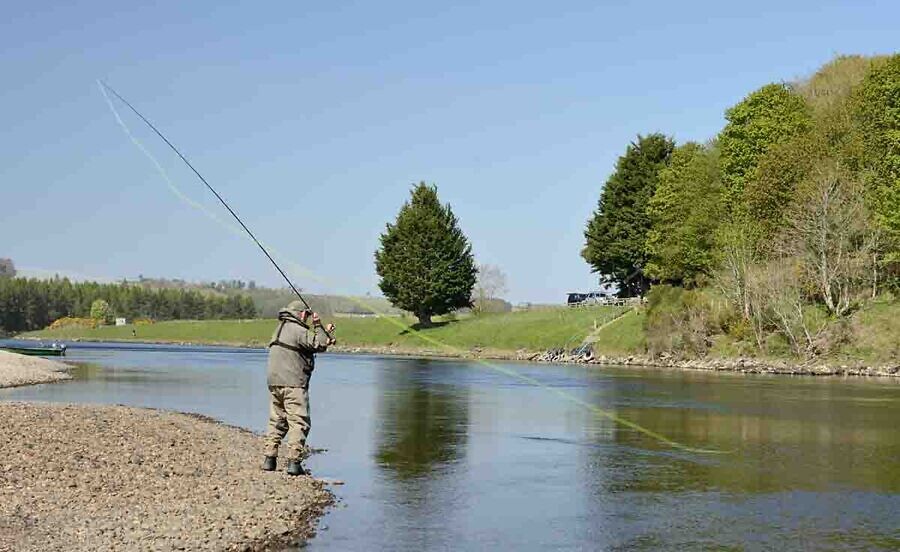
We dumped our anglers on a sandbar, the prop barely slowing while they assembled their gear, and then we were on our way, low and slow, 50 miles north past bears, bull moose, and the lava-black scar of a recent volcano toward a broad gravel track on the tundra.
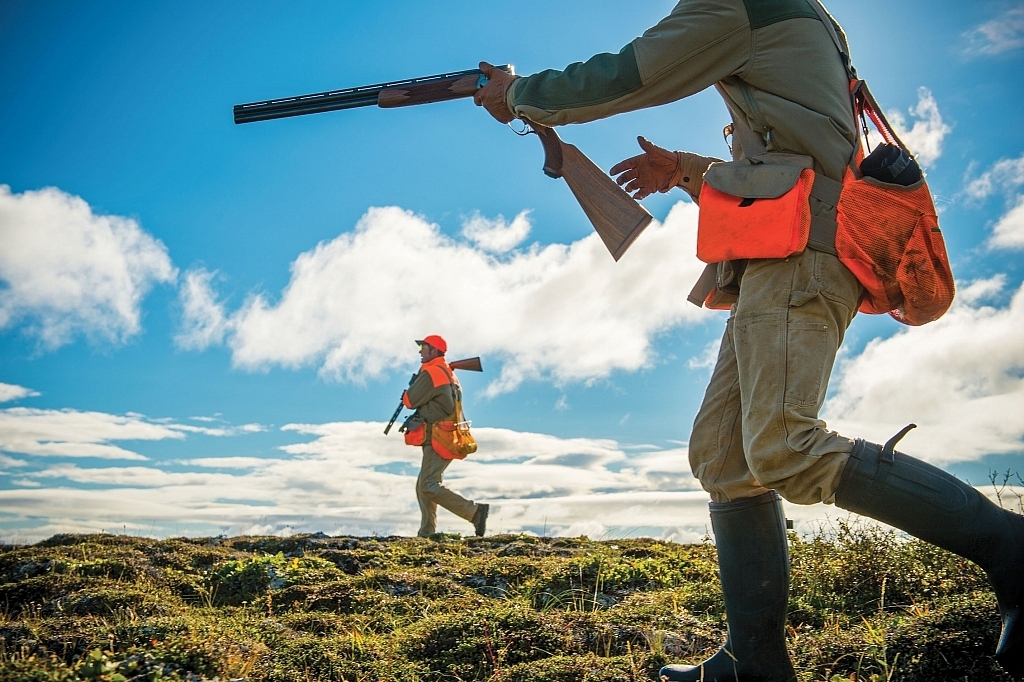
We banked, touched down, cut the engine, and let the silence fall. The biggest silence I’ve ever heard, even with the wind whipping and the willows rustling and the dog squirming around our legs. It made me feel fresh and new, as though scrubbed with raw soap and left out to dry in the wind. What an incredible place to start a day, I thought, as we uncased our 20-gauge doubles and filled our pockets with 3-inch number 6s. I hoped out loud that a couple of boxes between us would be enough, an idle gesture of nervous good humor. But for Dan it was straight logistics, because already, just past the edge of the gravel, a hollow clucking chimed in echo.
As soon as we untied him, English AK went on point, moving concertedly, in small fits and starts, up through the first willow break. Dan closed his gun and held it heavenward, and looked at me with a smile. His “Ready to run?” proved more statement than question. He scampered off into the brush and I followed, barely keeping up with AK in his stop-and-go creep, the clucking growing closer, seemingly just ahead of our boots.

Frozen moments: The author walks up a single under the watchful eye of AK the pointer.
The tundra is a sponge that steals back for itself a foot from every two feet of forward momentum, sucking the life from your legs along with it. But damned if I was going to let Dan get up on that first covey without me, so I flanked him wide left and beat through the waist-high willows, hoping, perhaps praying, that those birds would flush before I ran out of breath.
When you’ve dreamed so long and abstractly of something great, the immediacy of the real thing can lay you low. As I breached the end of the break and came in sight of my first covey of willow ptarmigan, it was almost too much to bear, a carnival of emotion and sound and color that threatened to split me wide open. But I’m glad to say that when that surge of movement changed from a mirage to by-god white-winged birds, all the pent-up yearning of an empty-handed New England bird shooter burst forth in a flurry of number 6 shot.
Of that covey, maybe 60 birds, one sympathetic soul fell dead. I knelt next it in the morning light and lifted it, smoothed and sniffed its feathers.
“Beautiful,” said Dan softly, from just behind me. It was the purest embodiment of that wild place I could imagine, and I might have stayed frozen there in reverie if Grossenbacher hadn’t thumped me on the head and said, “Any interest in making a day out of this?” He pointed toward AK, who was creeping again.
“Load up, my boy,” said Dan, beginning his tundra-trampoline run again, and chasing another hundred birds off into the dreamscape. “I don’t know how long this dog can wait on you.”
And so it went. Throughout my life, some days, even moments, have stood as barometers of perfection, an exquisite synthesis of friendship and joy and place. Sadly, many remain lost in childhood memories, unsullied by the cynicism (which some call realism) of adulthood.
I became a boy again, that day on the Alaska tundra. I ran across a landscape wholly wild with two friends, shooting guns and laughing out loud and witnessing the world as it looked when young, when everything was clean and unblemished by disbelief.
I shot birds till I had shot enough, till the vest straps pinched my shoulders. I ate my lunch in a place where no one but two friends and a dog named AK could see what I was seeing: the clouds breaking and spreading and casting shadows over Blue Mountain and the wolf tracks crisscrossing the gravel ribbon below. I took a little post-lunch nap there on the ground as the sun warmed us and the wind dropped and the bugs came out, and I slept only grudgingly, knowing that to sleep was to miss something. Maybe it was all a daydream after all; it sure felt like one.

The author approaches a little slice of the North.
We rallied when Grossenbacher rolled in his sleep and snorted, and Dan, the consummate Alaska bushman, sat bolt upright and yelled “Bear!”
Once we’d sorted that our demise wasn’t imminent, and that Grossenbacher’s rumblings were no cause for alarm, we tidied our gear and leashed AK and headed back over the final hump to the plane. As we walked, ptarmigan clucked all about us, hollow and ringing, and we were happy to know they remained—for us, for other bird shooters, or just for themselves. It was a festival of riches, out there by Blue Mountain, the rewards of autumn banked in a lifetime of bag limits, realized or not, in a wildness asserted, and recognized, and left to go white in the coming winter.
Coming home with me were a few fine meals and some feathers for my daughters, friendships forged over burnt powder and blood, and another tome on that special shelf where I keep my perfect days.
And, my wife will be pleased to know, the dog got some exercise, too.
Reid Bryant hunts and writes and dreams of Alaska from his home in central Massachusetts.
>If You Go
Willow ptarmigan hunting on the Alaska Peninsula begins August 10 and continues until the end of Crystal Creek’s season in mid-October. Beginning September 1, ptarmigan season coincides with the inland duck season and the peak of the silver salmon run, so a mixed-bag adventure is a wonderful approach.
Hunting the tundra is a poetic experience, but not for the faint of heart. Hunters should be in good physical condition, and prepared for a day’s run over spongy ground. An hour’s flight in one of CCL’s De Havilland Beavers is the normal pathway to the bird covers. Only rarely will a cover be hunted more than once a season.
CCL can provide firearms and common ammunition, but guests are encouraged to bring along a favorite upland gun: 12-, 16-, or 20-gauge doubles are the norm, as are relatively heavy number 6 loads. Ptarmigan cover is low and shots are fairly open, but they can be long, and mid-constriction chokes are a good bet. Lug-soled rubber boots, Gore-Tex brush pants, and a change of socks are welcome provisions when the willows are wet. Autumn weather on the Alaska Peninsula can change in an instant, so layers are a must.
For details, rates, and availability, see the Crystal Creek Lodge website at www.crystalcreeklodge.com, email [email protected], or call Dan Michels at (907)357-3153.