ANYONE ACCUSTOMED TO THE MODERN HUNTING LIFE of richly equipped lodges, where even the dog kennels have central heating, needs to undergo some mental adjustment before venturing onto the Crow Reservation. Although information about accommodations and so on rightly belongs in our “If You Go” section, finding a place to sleep is far from an afterthought. There is no place to stay in Crow Agency, and the nearest hotel is in Hardin, 30 miles farther west on Interstate 90. We set out from Colorado with Mark and Dinny hauling their Airstream and me following along. The only RV park near Crow Agency would be closed for the season, we knew, but we figured we could find something. The first couple of nights, we ended up at a no-services campground on the Tongue River, 50 miles to the south, at the end of a long, winding, and progressively narrower gravel road descending into a steep canyon. Aside from the fog and rain clouds, the sheer canyon walls allowed in about two hours of sunshine a day, which played havoc with the Airstream’s solar panels.
After three days, with our batteries almost dead, fresh water running low, and our nerves beginning to fray from stuffing three people and two large English setters into an Airstream built for two, we gathered everything up and beat it for Hardin, where the Airstream was checked into a local RV park (not quite closed for the season) and I (with immeasurable gratitude) took up residence in the nearby Super 8. Should you find yourself in similar circumstances, I recommend it highly. When I hunt the Crow again, and I shall, I’m going to the Super 8 straight off. It was a lesson well learned.
All this travail took place in between driving daily to meet up with Willie at his place outside Crow Agency, and trundling off toward the horizon in search of sharptails. I didn’t keep track of how many miles we drove, but I should have. It seemed that every day we went off in a different direction—one day out beyond the Little Bighorn battlefield, the next day northwest into the boondocks, the third day across ranch land south of the interstate.
Actually, we should start at the beginning of Day One, which was our day devoted to handling the Crow Nation game department paperwork. Having been there before, we knew the routine. With Willie running interference, we repaired at midmorning to the Crow administration building in the center of town. Down a long hall, around a couple of corners, and we encountered a large crowd, waiting. We joined them, and waited. Willie chatted with a few bystanders. We waited. The crowd grew, and waited. It turned out there was a staff meeting in progress upstairs, and the business of the Crow Nation, like the crowd downstairs, had to wait.
Toward midafternoon, we were called into the licensing office, run by a kindly old woman named Doreen, who looks like you wish your grandmother looked. Very deliberately, she took our names and details, pulled out a calculator, gave us a total, and Mark went off to the U.S. Post Office across the block to pay, in cash, for a USPS money order for the total—the only form of currency the Crow Nation will accept. The Crow take only postal money orders, and the post office takes only cash. That means you have to time this part of the proceedings to allow you to get to the post office before it closes. Otherwise, it means returning the next day to do most of it— including the waiting—all over again.
This is all just part of the adventure. At least, you keep telling yourself that. And imagining what it will be like once you are out on the range, with dashing dogs and flushing sharptails.

Far be it from me to suggest that Willie employed the guide’s old trick of deliberately putting us on a dry hole to walk off our excess energy and lower our expectations, but that is more or less what happened. Behind the battlefield, we pulled over beside a long valley with steep sides, and set the dogs out. An hour later, we reached the end without putting up so much as a meadowlark. Harry, the young setter, showed great interest in a patch of low brush, and a few seconds later large after the other, like handkerchiefs from a magician’s sleeve. I stopped counting after five. All ignored Harry with a disdain becoming of their species. That was the highlight. Alas, it also showed that Leon, the old setter, was having such serious lung problems that he was hors de combat for the duration.
With the dudes sufficiently tired out to enjoy sitting in a truck for a while, Willie led us off into the hinterland in serious search of sharptails.
ESSENTIALLY, WE FOLLOWED A SIMILAR SCRIPT for the next few days, and regularly saw grouse. When Willie pulled over and got out, we knew there would be sharptails nearby, and there always were. Why here, and not over there? Ask Willie. Generally, there would be a flock of 6 to 10, and we would drop one or two.
It seems to me that sharp-tailed grouse travel in coveys, but maybe not. Perhaps they end up in the same covert, much as a bunch of acquaintances might find themselves in the same saloon. We all noticed the difference from pheasants, however, in that the grouse would fly overhead and straight, and if we hit them, they came down and stayed where they landed. We examined one or two to see where they’d been hit, and couldn’t find a mark. We were all armed with doubles, using (in my case) B&P High Pheasant loads, with an ounce of #7s. Worked like a dream.

Willie thought we were a little undergunned at first, being used to clients who shoot at everything that flies, near or far, and want to kill as many birds as possible. Because the bag limits are set by the tribal game department, there is a certain flexibility you won’t find elsewhere. We found that we got enough shooting to make it worthwhile, and didn’t lose any sleep if we didn’t limit out (whatever that might be). Willie found our attitude refreshing.
And so we saw some great country. We visited a hollow that Custer used as a staging point before the battle, and then hunted down some draws from there, putting one or two birds in the bag. We even flushed a cock pheasant, which I dropped over the edge of a deep cut, and Harry not only plunged over after it, but brought it back in his mouth besides. Score one for dog training.
The most memorable day was the last one, when we ventured into the rolling, grassy ranch lands south of the interstate. The trucks were mostly in four-wheel drive, getting up the slopes. Willie suddenly stopped, not quite to the top, and motioned us to get out. Over the brow of the hill, hull-down as it were, we could see the heads of seven or eight sharptails, lined up and watching us.
“A sharptail rose in front of Mark, maybe 20 yards out, and he dropped him smartly in a cloud of smoke.”
Mark went out that day with his Joseph Manton flintlock, more than two centuries old, a gun that was already obsolete when the Sioux fought Custer, and he was intent on getting a sharptail with it. The year before, he and Willie stalked some pronghorns to within 30 yards, and he dropped one with a John Dickson caplock rifle, so the Manton was this year’s eccentricity. We chased those sharptails over, around, down, and back up a bunch of hills, never getting a shot as they flushed out of range, but generally made their way down to a long, meandering, brushy draw.
“They really like it down there,” Willie murmured to me. “If they’re not up here feeding, they’re usually down in those bushes.”
We split up, with me going to the right and everyone else to the left around a hilltop and down the other side. Birds flushed in ones and twos and threes, well out of range, but all heading for the draw. As I approached the bushes, two sharptails went up on the far side, and I dropped one. About 50 yards farther on, exactly the same thing happened, and with two birds in the bag I was feeling pretty good.

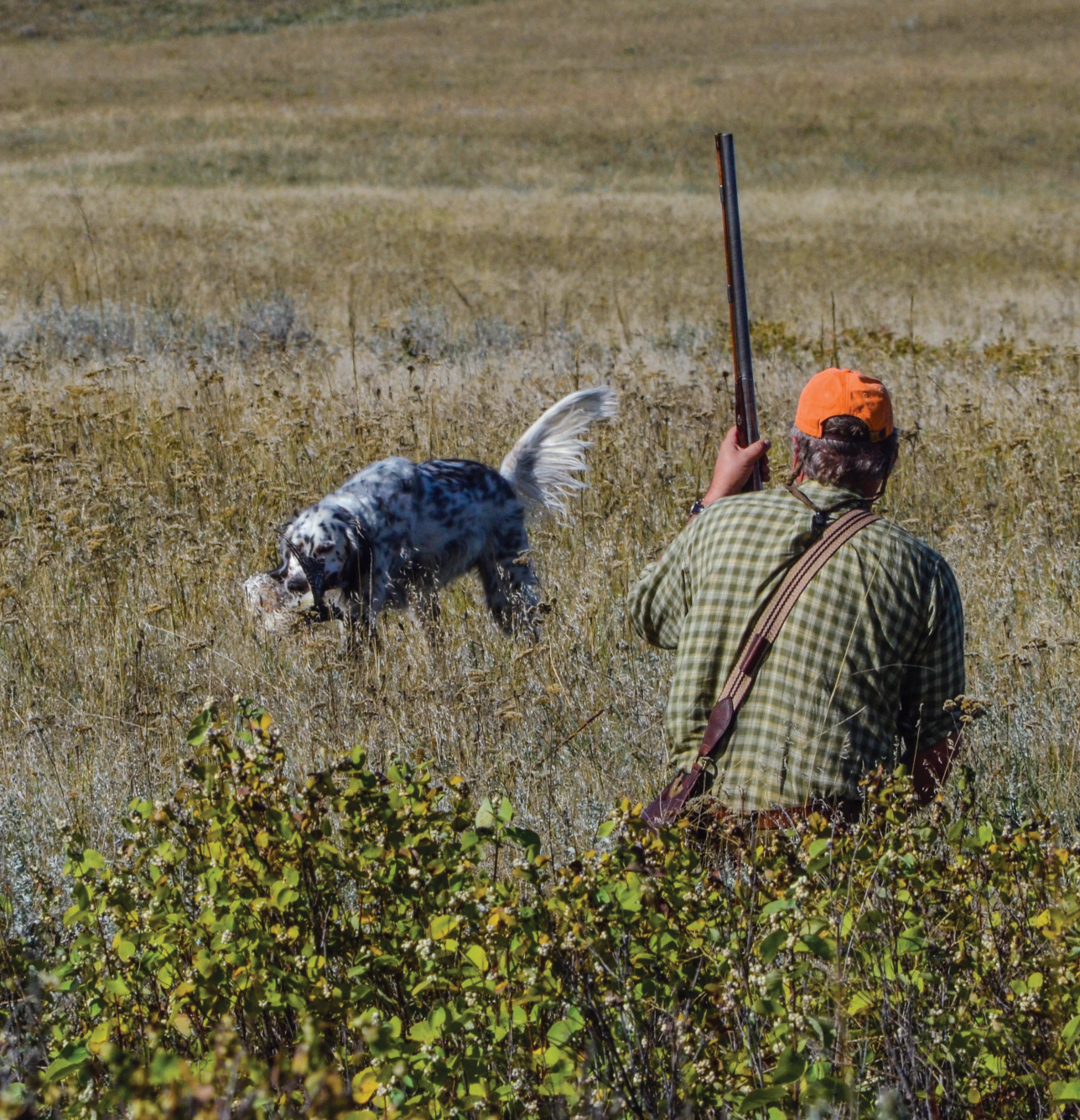
Farther on, I could see Mark with his Manton, working along one edge while Dinny took the other side and Harry dashed in and out of the brush. A sharptail rose in front of Mark, maybe 20 yards out, and he dropped him smartly in a cloud of smoke. With one bird to the credit of the elegant old musket, it seemed like the perfect time to stop for lunch.
We climbed back up to our trucks, and Willie led us down into a high draw that was out of the ever-present wind. We circled the wagons, got out the lunch hamper, and the dogs stretched out in the stubble, waiting for the inevitable goodies.
“I like hunting with you guys,” Willie said. “A lot of hunters come out here, and all they want to do is shoot and shoot and shoot. They’re not happy until they’ve hunted down every bird.”
He unwrapped another Snickers bar. What do you do then? I asked. You don’t want them to wipe out every bird in these private little hotspots of yours.
“Oh, there are ways.” Willie munched. “It’s good to know which of these draws always have birds in them.”
“On the other hand, it’s sometimes good to know which ones don’t.”
Maybe it’s the legacy of a childhood chasing ruffed grouse in the north woods, where birds were few and birds in the bag were fewer still, but Wieland always feels a sense of great gratitude when he gets more than a half dozen shots in a given morning. Also, there is nothing like hunting wild birds in wild country. Nothing.