A page from Jahangir’s Shikarnama, or hunting book, shows him with a pile of rhinoceros and blackbuck, having descended from his elephant after shooting a lioness. In another, he is courageously using his spear to save a man being mauled by a lioness.
Many Mughal hunting techniques were based on a 12th century Sanskrit encyclopedia, Manasollasa, which describes 35 different methods, from shooting over waterholes to Balivardatirodhana, or hiding behind bullocks to move in on the quarry. Hake is getting game within the posted king’s range. Lassoing deer was also practiced.

To hunt blackbuck, Jahangir sometimes used a trained, castrated ram and a ewe, as decoys to lure in wild antelope. The hunters would crawl as close as possible, then jump up and surprise the lusty pack, giving the king the chance to shoot one fleeing. In 1607, when Jahangir’s favorite pet blackbuck, Mansraj, was accidentally killed on his hunting retreat near Lahore, Jahangir erected a 30-meter-high brick Hiran Minar (deer tower) as its monument and tomb.
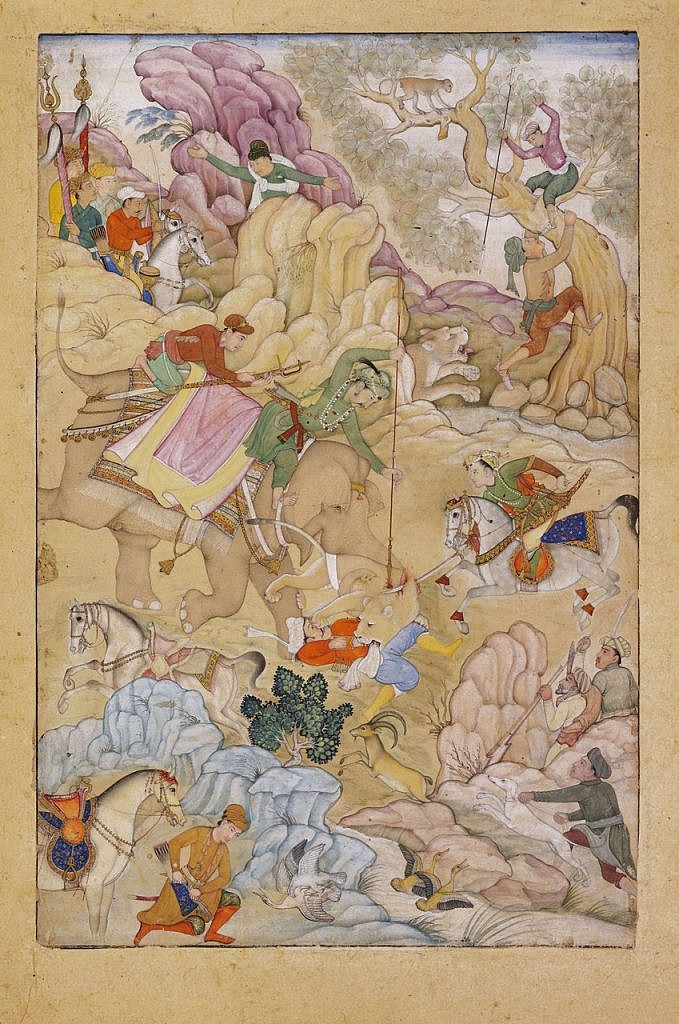
Shah Jahan (1592–1666), the builder of the Taj Mahal, hunted blackbuck, lion, and tiger, and also pursued nilgai with cheetahs. One miniature shows him calmly and elegantly dressed, hunting lions from elephant-back at Burhanpur. Shah Jahan is responsible for his huntsmen wearing green as camouflage, as in the miniature depicting four hunters hiding behind branches to sneak up on nilgai. Another shows the emperor dressed in green—a fashion that carried over into the court—shooting wild animals drawn to his decoys, his royal matchlock steadied by a branch. At dawn, bathed in morning light, his halo is colored gold.

Eventually, the emperors’ imperial hunting grounds, called shikargah, served as de facto game preserves, although they were greatly exploited by British hunting parties during the Raj. Of the 70 former shikargah, several have become national parks, including Jim Corbett National Park and the tiger reserve, Bandhavgarh National Park.
If visiting the David Collection, Brooke Chilvers recommends lunch at Orangeriet in a former conservatory in the King’s Garden, across the street from the museum.